
Winter trucking in Canada runs on tighter margins than any other season. From November to March, freight moves through blowing snow on the 401, avalanche-control closures in the Rockies, prairie whiteouts and temperatures that can freeze fuel, air brakes and the cargo itself. Most loads still arrive on time, but only because carriers and shippers plan for the cold instead of hoping it stays away.
For shippers, winter shows up in three ways: longer and less predictable transit times, extra handling for freight that cannot freeze, and costs that creep up through surcharges, layovers and heated equipment. Knowing where those risks come from makes it much easier to book the right service, set realistic delivery dates and avoid a frozen or damaged load.
This guide covers the eight biggest challenges of moving freight by truck in a Canadian winter, from fuel gelling and chain laws to seasonal weight rules and Protect From Freeze service, and then turns them into practical steps you can take before you book. If you have a winter shipment coming up, our truck freight services cover full loads, partial loads and cross-border moves across Canada.
8 Challenges of Winter Trucking in Canada at a Glance
The table below summarizes the main winter risks and what each one means for a shipment. The sections that follow explain them in more detail.
| Challenge | What happens | What it means for shippers |
|---|---|---|
| 1. Fuel gelling and DEF freezing | Diesel waxes in deep cold; DEF freezes at about -11°C | Breakdowns and roadside delays on cold runs |
| 2. Frozen air brakes and equipment | Moisture freezes in air lines, valves and trailer doors | Slower pre-trip checks and occasional equipment failures |
| 3. Road closures and mountain passes | Storms and avalanche control close key highways | Transit times stretch by hours or days |
| 4. Chain and winter tire laws | B.C. requires chains on heavy trucks from October 1 | Fewer carriers willing or equipped to run some lanes |
| 5. Seasonal weight rules | Winter weight allowances, then spring road bans | Payload limits can change by month and province |
| 6. Freight that cannot freeze | Liquids, paints, chemicals and food can be ruined | Need for heated, Protect From Freeze service |
| 7. Driver hours and safety stops | Drivers must stop when conditions are unsafe | Layovers, missed appointments and re-deliveries |
| 8. Terminal and yard slowdowns | Snow-clogged yards, frozen equipment, short staffing | Longer dwell times at docks, rail ramps and warehouses |
1. Fuel Gelling and Frozen DEF
Diesel contains paraffin wax that starts to crystallize as the temperature falls. Below the fuel’s cloud point, those crystals clog filters and starve the engine, which is what drivers mean by “gelled” fuel. Canadian diesel is blended to prevent this: under the national standard, fuel is formulated for the low temperatures expected in each region and half-month, so a fuel station in Winnipeg in January sells a very different product from one in Windsor in October.
Problems usually appear when a truck fuels up in a milder region and then runs into deep cold, during a sudden cold snap that outpaces the seasonal blend, or when biodiesel content raises the cloud point. Diesel exhaust fluid (DEF) is another weak spot, because it freezes at about -11°C. Modern trucks heat their DEF tanks, but a failed heater can trigger engine power limits on the highway.
That is why fuel is one of truckers’ biggest challenges in winter. Professional carriers manage it with winter-grade fuel bought locally, anti-gel additives, fuel and filter heaters, block heaters at overnight stops, and full tanks to limit condensation. They also carry spare fuel filters, since a clogged filter is the most common cold-weather failure. For shippers, the takeaway is simple: on long cold-weather lanes, an experienced carrier with winterized equipment is worth more than a slightly cheaper rate.
2. Frozen Air Brakes and Equipment
Heavy trucks use compressed air for their brakes, and compressed air carries moisture. In freezing weather, that moisture can turn to ice in air lines, valves and brake chambers, causing brakes that drag, will not release or respond poorly. Carriers prevent it with air dryers, regular draining of air tanks and careful pre-trip inspections, which take longer in winter than in summer.
The cold affects almost everything else on the truck as well. Batteries lose capacity, rubber seals and hoses stiffen, trailer doors freeze shut and landing gear can seize. Reefer and heater units have to start reliably at -30°C. Each of these can add time at pickup or at a stop, and a single frozen component can hold a load until a mechanic arrives.
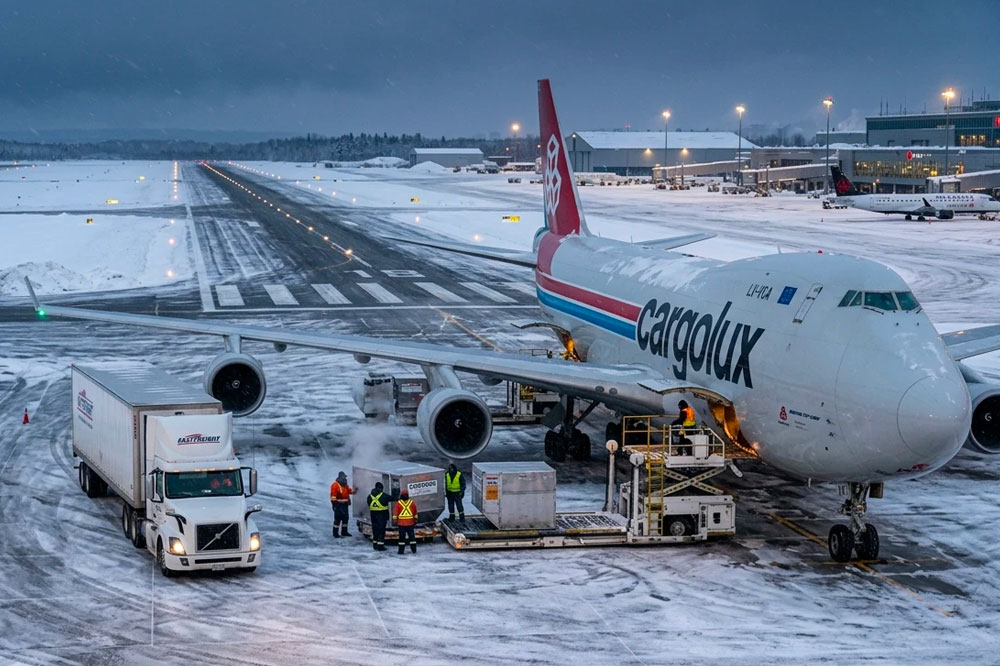
3. Road Closures and Mountain Passes
Winter storms close highways across the country every season. In Ontario, lake-effect snow squalls can shut stretches of the 400-series highways with little warning. On the Prairies, blowing snow and whiteouts close the Trans-Canada and Yellowhead for hours at a time. In British Columbia, mountain routes such as the Coquihalla, Rogers Pass and the Kootenay Pass face heavy snowfall and scheduled avalanche-control closures.
For a cross-country load, a closure in one place can ripple through the whole schedule. A truck held for twelve hours at Rogers Pass may miss its delivery appointment in Vancouver, then wait for a new slot. Alternative routes through the United States or other passes exist on some lanes, but they add distance and, for cross-border detours, customs paperwork.
This is the main reason winter transit times are longer. On the Toronto to Vancouver lane, a load that takes about five to seven days in summer can take several days longer in January. Good dispatchers track road reports and weather forecasts and reroute early, but no one can drive through a closed highway. When you book in winter, build a buffer of one to three days into any delivery date that matters, especially on western routes. Our guide to cross-border shipping between Canada and the U.S. covers what changes when a load is routed through the States.
4. Chain and Winter Tire Laws
British Columbia has the strictest winter equipment rules in Canada. From October 1 to April 30, most B.C. highways require winter tires and chains, with some lower-risk routes ending the requirement on March 31. Commercial vehicles with a licensed gross vehicle weight of 11,794 kg or more, which includes tractor-trailers, must carry steel chains on most major highways outside the Greater Vancouver and Greater Victoria areas, and must put them on when signs or conditions require it.
Chaining up a tractor-trailer takes time and has to be done at designated chain-up areas, often in the dark and the cold. When chains are mandatory, traffic slows and some carriers simply avoid mountain routes for parts of the season. Quebec and other provinces have their own winter tire rules, mostly aimed at light vehicles, while long-haul fleets generally fit traction-rated drive tires for the whole winter.
For shippers, the practical effect is capacity. Fewer trucks are willing and equipped to run the B.C. interior in the depth of winter, so rates on western lanes can be firmer and booking lead times longer. If you ship regularly into or through British Columbia, book earlier in the week and ask your forwarder whether your carrier is set up for mountain driving rather than assuming every truck is.
5. Seasonal Weight Rules: Winter Weights and Spring Thaw
Winter actually helps payloads in some provinces. When the ground is frozen, roads can carry more weight without damage, so several provinces allow higher weights on certain highways in winter. In Saskatchewan, for example, winter weight allowances typically run from mid-November to mid-March, starting later in the southwest, and are postponed when mild weather delays the freeze.
The opposite happens when the thaw arrives. As frost leaves the ground in spring, roads are at their weakest, and provinces impose spring road bans or reduced load periods on many secondary highways, typically from early March into April or May depending on the region and the weather. Major highways are usually exempt, but the restrictions often apply to the rural roads that lead to farms, mills, plants and small towns.
If your freight starts or finishes on a secondary road, spring restrictions can mean lighter loads, more trucks to move the same tonnage, or detours to the nearest unrestricted route. That changes cost as well as timing. Plan heavy shipments to rural sites for winter or after the bans lift, and ask your carrier to check the current orders before quoting. For heavy or oversized freight, our full truckload (FTL) service can plan routes around these restrictions.
6. Freight That Cannot Freeze: Protect From Freeze Service
Some freight is ruined by a single night below zero. Beverages, liquid soaps, paints, coatings, adhesives, latex products, some chemicals, cosmetics, pharmaceuticals, fresh produce and many food products can freeze, separate, crack their containers or lose their properties. For these goods, a standard dry van is not enough between roughly November and March in most of Canada.
Protect From Freeze (PFF) service uses heated trailers, or reefer units set to heat, to keep freight above a set minimum, usually a few degrees above freezing, for the whole trip, including overnight stops and terminal dwell. PFF capacity is more limited than dry van capacity, it costs more, and it is especially tight in LTL networks, where freight may sit in a terminal between trucks. Some LTL carriers offer heated service on certain lanes only.
The most common mistake is forgetting to mark freight as PFF at booking. A pallet of paint that freezes in an unheated terminal is usually not covered by the carrier, and insurers may decline claims where the right service was not requested. Always state temperature requirements on the bill of lading and in your booking, label the pallets, and ask how the carrier protects freight during terminal stays. If your products are regulated, our dangerous goods shipping team can confirm handling and temperature requirements, and our LTL shipping page explains how partial loads move through terminals.
7. Driver Hours and Safety Stops
Canada’s federal hours-of-service rules limit how long a commercial driver can drive and be on duty. They include an allowance for adverse driving conditions: when unexpected weather slows a trip, a driver may extend driving time by up to two hours to finish a trip that could have been completed in normal conditions, as long as the required eight consecutive hours off duty are still taken. That flexibility helps, but it does not allow a driver to keep going through a storm indefinitely.
In practice, safe drivers stop when roads become dangerous, whatever the delivery schedule says. A professional carrier will park a truck rather than risk a jackknife on black ice, and good shippers expect and support that decision. The cost is time: a storm stop can push a delivery into the next day, and if the driver runs out of hours waiting, the load may need another overnight.
These delays create knock-on charges. Missed appointments can lead to re-delivery fees, and long waits at docks can trigger detention or layover charges. Our guide to freight accessorial charges explains how detention, layover and re-delivery fees work and how to keep them under control. Flexible delivery windows in winter are one of the simplest ways to avoid them.
8. Terminal, Yard and Warehouse Slowdowns
Winter slows down the places where freight changes hands. Snow has to be cleared from yards and docks, frozen trailer doors and landing gear take time to free, and staff shortages during storms reduce how many trucks a terminal can handle in a shift. Rail intermodal ramps and port container yards face the same problems, which can delay drayage moves and container pickups.
For LTL freight, every extra day in a terminal is another day of exposure to cold and handling. For containers, slower terminals can mean storage, demurrage or detention charges that have nothing to do with the importer. Warehouses also see more damage claims in winter, because freight arriving wet with snow or ice can stain, warp or freeze before it is unloaded.
You can reduce these risks by choosing direct full truckload service for sensitive freight, keeping your own receiving docks clear and staffed, and avoiding long dwell times between modes. If your supply chain needs a buffer, short-term storage in a heated facility can keep inventory moving even when transport is disrupted; our warehousing services can hold freight close to your customers through the worst weeks of winter.
How Winter Affects Freight Costs and Transit Times
Winter rarely changes the base price of a truckload on its own, but several factors push the total cost up. Fuel surcharges follow diesel prices, which often rise in winter. Heated PFF service costs more than a standard dry van. Delays create detention, layover and re-delivery charges, and western mountain lanes can carry firmer rates because fewer carriers run them. Weight restrictions in spring can mean more trucks for the same volume.
Transit times stretch too. A useful rule of thumb is to add one day to regional moves and one to three days to long-haul and cross-country moves from December to February, and more for routes through the B.C. mountains or remote northern regions. Car shipping follows the same pattern, with winter salt and slower highways adding time; our guide to car shipping costs in Canada explains when enclosed transport is worth it in the cold months.
Insurance deserves a look as well. Freeze damage, weather delays and accidents are more common in winter, and carrier liability is limited. If your freight is valuable or temperature-sensitive, compare the cost of cover with what you could lose; our article on cargo insurance costs shows how small the premium usually is compared with the value it protects.
How to Plan a Winter Shipment: A Shipper’s Checklist
Most winter problems can be avoided with a little planning before the truck is booked. Use this checklist for shipments between November and April:
- Book earlier: give carriers more lead time, especially for western lanes, heated service and the weeks around the holidays.
- Declare temperature needs: mark Protect From Freeze freight at booking, on the bill of lading and on the pallets.
- Build in buffer days: set delivery dates with one to three extra days on long routes, and avoid hard deadlines right after a storm forecast.
- Package for the cold: use pallets, shrink-wrap and moisture protection, and secure loads so they cannot shift on icy roads.
- Keep docks ready: clear snow and ice, and staff receiving so trucks are not left waiting.
- Choose direct service for sensitive freight: full truckload limits terminal dwell and handling.
- Check spring restrictions: for rural pickup or delivery sites, ask your carrier about current road bans.
- Review insurance: confirm what is covered for freeze damage and delays before the freight moves.
Working with a forwarder that knows Canadian winter lanes makes these steps easier. A good forwarder will match your freight with a carrier that has the right equipment, flag routes likely to be affected by weather, and keep you informed when conditions change. When you are ready, get a winter freight quote with your pickup and delivery details and any temperature requirements.
Frequently Asked Questions About Winter Trucking
What are truckers’ biggest fueling challenges in winter?
Diesel gelling in deep cold, water and ice in fuel systems, and frozen diesel exhaust fluid. Carriers manage these with winter-grade fuel, anti-gel additives, fuel heaters, block heaters and spare filters.
How much longer does trucking take in winter?
As a rough guide, add about a day to regional moves and one to three days to long-haul routes from December to February, with more time for B.C. mountain routes and northern destinations.
Does freight cost more in winter?
Base rates do not always change, but fuel surcharges, heated service, detention and layover charges often raise the total cost, and western lanes can be firmer when fewer carriers run them.
What freight needs Protect From Freeze service?
Liquids, beverages, paints, coatings, adhesives, many chemicals, cosmetics, pharmaceuticals and food products that can be damaged by freezing.
Do trucks need chains in Canada?
In British Columbia, tractor-trailers must carry steel chains on most major highways from October 1 to April 30, outside Greater Vancouver and Greater Victoria.
Keeping Freight Moving Through a Canadian Winter
Winter trucking in Canada is demanding, but it is also routine for carriers who plan for it. The main risks are well known: fuel and equipment problems in deep cold, closures on key highways and mountain passes, chain laws and changing weight rules, freight that cannot freeze, driver safety stops and slower terminals. Each one is manageable when the right equipment, routing and timing are in place.
For shippers, the best defence is early planning. Book sooner, declare temperature needs clearly, build buffer days into delivery dates, package for cold and moisture, and choose direct service for sensitive freight. Those few steps prevent most of the delays, damage and surprise charges that make winter shipping stressful. Rail can also be a useful alternative on some long-distance lanes; our rail shipping services explain when it makes sense.
Cargopedia arranges truck freight across Canada and into the United States all year, including heated service for freight that must not freeze. Tell us what you are shipping, where it is going and when it needs to arrive, and request a quote for your winter shipment. We will match it with the right carrier and equipment for the season.