
Cargo ships are the merchant vessels that carry goods across oceans, along coastlines and up major rivers, and they move the large majority of world trade by volume. The eight main types of cargo ships are container ships, bulk carriers, tankers, Ro-Ro and car carriers, reefer ships, general cargo ships, multi-purpose vessels and heavy-lift ships. Each one is built around a different kind of cargo: boxes, loose dry commodities, liquids, vehicles, chilled goods, breakbulk or oversized project freight.
The type of ship matters to shippers more than it might seem. It decides how your goods are loaded and stowed, which ports can handle them, how often a service sails, and what you pay at both ends. A pallet of retail goods, a shipload of grain, a used car and a 200-tonne transformer may all cross the same ocean, but they will travel on very different vessels and under very different rules.
This guide explains what each type of cargo ship carries, how big and fast they are, which ones call at Canadian ports, and how to tell which option fits your shipment. If you are planning an ocean shipment now, our ocean freight services cover full container, shared container and specialized cargo moves to and from Canada.
Types of Cargo Ships at a Glance
The table below summarizes the eight main types of cargo ships and what each one carries. The sections that follow explain how they work and when each one is used.
| Type of cargo ship | What it carries | How capacity is measured |
|---|---|---|
| Container ships | Manufactured goods, retail products, electronics, parts and most boxed freight | TEU (twenty-foot equivalent units) |
| Bulk carriers | Grain, coal, iron ore, potash, fertilizer, cement and other loose dry cargo | Deadweight tonnes (DWT) |
| Tankers | Crude oil, refined fuels, chemicals, vegetable oils, LNG and LPG | DWT or cubic metres |
| Ro-Ro and car carriers | Cars, trucks, trailers, buses and wheeled or tracked equipment | Lane metres or car units |
| Reefer ships | Fruit, vegetables, seafood, meat and other temperature-controlled cargo | Refrigerated cubic capacity |
| General cargo ships | Breakbulk steel, timber, pipes, bagged goods and machinery | DWT and hold volume |
| Multi-purpose vessels | A mix of containers, breakbulk and project cargo on one voyage | DWT, TEU and crane capacity |
| Heavy-lift ships | Transformers, turbines, refinery modules and very heavy project units | Lifting capacity in tonnes |
What Is a Cargo Ship? Size, Speed and Capacity
A cargo ship, also called a freighter, cargo vessel or freight ship, is any merchant ship designed to carry goods rather than passengers. Cargo ships range from small coastal freighters a few dozen metres long to container ships about 400 metres long, roughly the length of four football fields end to end. The largest container ships in service today can carry around 24,000 TEU, which is enough space for roughly 12,000 forty-foot containers.
Different ship types are measured in different ways, which is why you will see several units in shipping quotes and reports. Container ships are rated in TEU, the number of twenty-foot containers they can hold. Bulk carriers and tankers are rated in deadweight tonnes (DWT), the total weight of cargo, fuel and stores the ship can carry. Ro-Ro vessels are planned in lane metres, the length of deck space available for vehicles.
Cargo ships are slower than most people expect. Many container ships can sail at over 20 knots, but carriers often run them far slower to save fuel and cut emissions, a practice known as slow steaming; average container ship speeds have recently been around 14 knots, and bulk carriers closer to 11 knots. Even the largest ships run with small crews, usually around 20 to 25 people, thanks to automation. For shippers, slow steaming is one reason a sailing from Asia to Canada’s west coast takes around two weeks or more on the water before the rail or truck leg even starts.
1. Container Ships
Container ships carry the goods most businesses import and export: consumer products, furniture, clothing, electronics, auto parts, machinery and packaged food. Everything travels in standard steel containers, usually 20 or 40 feet long, which are stacked in the holds and on deck and moved by gantry cranes at specialized terminals. Because containers are standard, the same box can move from a factory in Asia to a ship, a train and a truck without the cargo being touched.
Container ships come in several size classes. Small feeder ships connect regional ports to larger hubs. Panamax and neo-Panamax ships are sized for the Panama Canal locks, and ultra-large container vessels serve the busiest Asia–Europe and transpacific routes where ports have the depth and cranes to handle them. Most operate on fixed liner services, calling at the same ports on a weekly schedule, which gives shippers predictable sailing dates.
You can book a whole container (FCL) or share space with other shippers (LCL), depending on volume. Our guide to LCL vs FCL shipping explains the trade-offs. The ocean crossing is rarely where costs go wrong; cut-off times, container release, port congestion, and demurrage and detention charges are where a well-managed booking saves money.

2. Bulk Carriers
Bulk carriers move unpackaged dry cargo poured or dropped directly into large holds: grain, coal, iron ore, potash, fertilizer, cement, sugar and wood pellets. They are the workhorses of commodity trade and make up a large share of the world’s merchant fleet by tonnage. In Canada they matter enormously, because exports of grain, potash, coal and other resources leave through west coast ports and the St. Lawrence on bulk ships.
Bulk carriers are grouped by size. Handysize and Supramax ships, typically up to about 65,000 DWT, often carry their own cranes and can serve smaller ports. Panamax ships are sized for the original Panama Canal locks, and Capesize ships, usually 100,000 DWT or more, are too large for the canal and mainly carry iron ore and coal between major ports with deep berths and heavy loading equipment. Lakers are a Canadian and U.S. specialty, built to fit the locks of the St. Lawrence Seaway and the Great Lakes.
Bulk shipping works very differently from container shipping. Instead of booking space on a scheduled service, cargo owners usually charter a whole ship or part of one, and the price depends on vessel size, loading and discharge rates, port costs and time in port. Delays at the berth can trigger demurrage, so loading plans and port capacity have to be matched carefully to the ship.
3. Tankers
Tankers carry liquid cargo in bulk, and they come in several specialized forms. Crude oil tankers move unrefined oil from production regions to refineries. Product tankers carry refined fuels such as gasoline, diesel and jet fuel. Chemical tankers have coated or stainless steel tanks and segregated systems so they can carry several different chemicals at once without contamination. Gas carriers move liquefied natural gas (LNG) at about -162°C, or liquefied petroleum gas (LPG) under pressure or refrigeration.
Tankers range from small coastal ships of a few thousand tonnes to very large crude carriers of around 300,000 DWT. Their design focuses on containment and safety: double hulls, inert gas systems, cargo segregation and strict vapour control. Before a tanker is accepted for a cargo, charterers and terminals usually require vetting inspections and detailed documentation.
On Canada’s coasts, tankers carry petroleum products, chemicals and vegetable oils in and out of ports such as Vancouver, Saint John and Montreal. Smaller volumes of liquids, from industrial chemicals to food-grade oils, usually do not travel on a tanker at all but in ISO tank containers aboard container ships. If your liquid cargo is regulated, our dangerous goods shipping team can advise on packaging, classification and the right equipment.
4. Ro-Ro Ships and Car Carriers
Roll-on/roll-off (Ro-Ro) ships carry cargo that can be driven or towed aboard through large stern or side ramps. Pure car and truck carriers (PCTCs) are the most familiar version: tall, box-shaped ships with up to a dozen internal decks that can carry several thousand vehicles. Other Ro-Ro designs carry trucks, trailers, buses, farm machinery, mining trucks and other heavy wheeled or tracked equipment, often called high-and-heavy cargo.
Capacity is planned in lane metres and deck heights rather than weight or volume, and ramp and deck strength decide which heavy units can be loaded. Because vehicles are simply driven on and off, Ro-Ro is usually the most economical way to ship cars overseas, but the vehicle must run, and personal items generally cannot be left inside. Container shipping is the alternative when you want the vehicle fully enclosed or need to ship personal effects with it.
Car carriers call regularly at Canadian ports, bringing new vehicles from Asia and Europe and carrying exports and used vehicles outbound. For a full comparison of the options for vehicles, see our guide to RoRo vs container vs air freight, or learn how our car shipping services handle vehicles moving within Canada or overseas.
5. Reefer Ships
Reefer ships are refrigerated cargo vessels with insulated holds that keep perishable goods at controlled temperatures, from chilled fruit to deep-frozen fish and meat. Traditional reefer ships often carry palletized cargo such as bananas or citrus loaded through side doors or by crane, and they are still used on some high-volume seasonal fruit and seafood trades.
Most perishable cargo today, however, travels in refrigerated containers on regular container ships. Each reefer container has its own cooling unit that plugs into the ship’s power supply, so a shipper can send one container of frozen seafood or pharmaceuticals on a weekly liner service instead of waiting for a dedicated reefer vessel. That flexibility is why container ships now carry most of the world’s seaborne perishables.
Whichever option is used, the risk is the same: a break in the cold chain at the port, on the ship or during inland transport can ruin a shipment. Temperature settings, ventilation, pre-cooling, monitoring and plug-in time at terminals all need to be planned in advance. Reefer cargo also faces stricter inspection and documentation rules for food and medical products at the Canadian border.
6. General Cargo Ships
General cargo ships carry breakbulk freight, meaning goods loaded piece by piece rather than in containers or as loose bulk. Typical cargo includes steel coils and beams, timber and lumber, pipes, bagged goods, paper rolls and machinery. Many general cargo ships are geared, meaning they have their own cranes, so they can load and discharge in ports with little shore equipment.
Breakbulk shipping remains important for cargo that is too long, heavy, awkward or valuable to put into containers, and for trade with ports that lack container terminals. Canada’s forestry and steel sectors still use breakbulk extensively; on the west coast, breakbulk carriers move forestry products and steel pipe, and on the east coast they serve industrial and resource projects.
Planning breakbulk cargo takes more work than booking a container. Each piece needs to be measured and weighed, lifting points and packaging must be suitable for crane handling, and the cargo must be secured in the hold or on deck against movement at sea. Stowage plans, lashing and port handling all affect the cost, which is why breakbulk is usually quoted shipment by shipment rather than from a tariff.
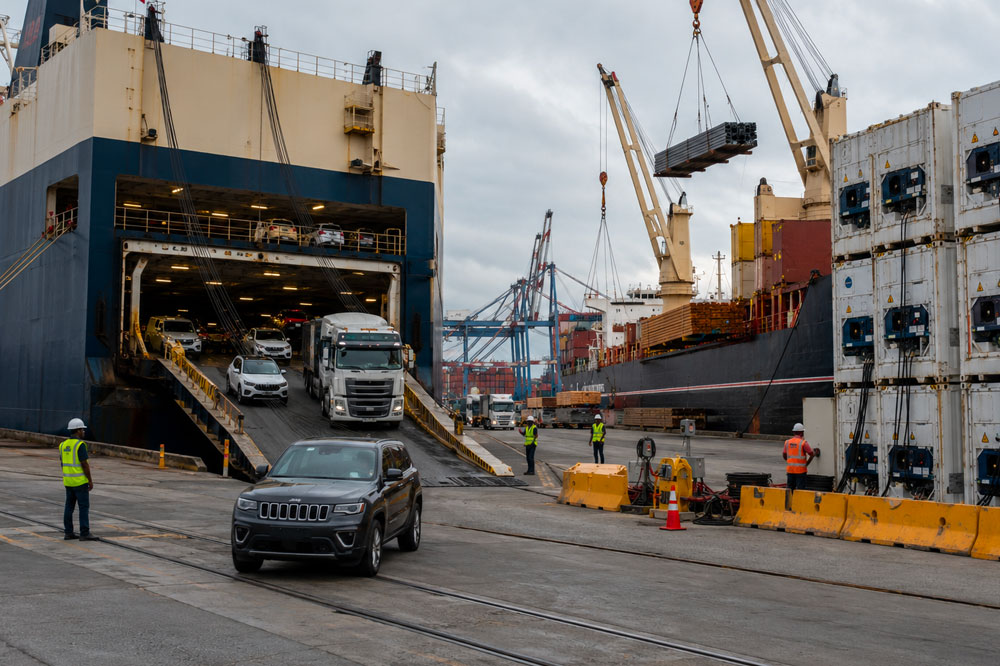
7. Multi-Purpose Vessels and 8. Heavy-Lift Ships
Multi-purpose vessels (MPVs) are designed to carry several kinds of cargo on one voyage: containers on deck, breakbulk in the holds and project cargo wherever it fits. They usually have strong onboard cranes, open box-shaped holds and movable tween decks. That flexibility makes them ideal for project shipments, mixed cargo and remote destinations with limited port infrastructure, including northern and Arctic communities.
Heavy-lift ships go a step further. Their cranes can lift hundreds of tonnes, and on some ships more than 1,000 tonnes when two cranes work together, and some semi-submersible designs can sink their decks below the water to float very large structures aboard. They carry power transformers, wind turbine components, refinery and mining modules, port cranes, offshore structures and other units far beyond the limits of any container or standard hold.
Shipping on these vessels is engineering work as much as logistics. Lifting studies, deck strength calculations, sea fastening design, route surveys and permits for the inland legs all have to be in place before the cargo moves. Timing is critical too, because heavy-lift sailings are limited and project schedules depend on them. Our project cargo services coordinate this kind of oversized and heavy shipment from origin to site.
Which Cargo Ships Call at Canadian Ports?
Canada’s ports see every major type of cargo ship, but the mix differs by coast. On the west coast, bulk carriers dominate. In a breakdown of pilotage assignments by BC Coast Pilots, bulk carriers carrying coal, grain and other commodities made up more than half of large-ship movements, followed by container ships, tankers, breakbulk carriers and car carriers. The Port of Vancouver and Prince Rupert are also Canada’s main gateways for containers from Asia, with much of that cargo moving east by rail.
On the east coast, Halifax is a deep-water port that can receive some of the largest container ships calling on North America’s Atlantic coast, while Saint John handles containers, bulk and liquid cargo. Montreal, roughly 1,600 km inland on the St. Lawrence, is one of Canada’s busiest container ports, served by ships sized for the river channel, and it links directly to rail networks into Ontario and the U.S. Midwest. Further inland, lakers and ocean-going bulk ships use the St. Lawrence Seaway to reach Great Lakes ports.
For most importers and exporters, this means the choice of Canadian port affects transit time and inland cost as much as the ship does. Cargo for Toronto from Asia can arrive through Vancouver or Prince Rupert and move east by rail, or come via the Suez or Panama routes to Montreal or Halifax. Our guide to sea freight transit times in Canada explains how these routings compare.
How to Choose the Right Type of Cargo Ship for Your Shipment
For most businesses, the ship type is decided by the cargo rather than chosen from a menu. Packaged and palletized goods almost always travel by container ship, either in a full container or consolidated with other shippers. Vehicles usually go by Ro-Ro or in a container. Loose commodities in large volumes need a bulk carrier or tanker, while oversized, very heavy or awkward pieces go breakbulk on a general cargo, multi-purpose or heavy-lift ship.
The decision gets more interesting at the edges. A large machine might fit in an open-top or flat-rack container on a regular container ship, which is often faster and cheaper than breakbulk, or it might be too wide and need a multi-purpose vessel. A small quantity of liquid might go in drums inside a container, in an ISO tank, or on a tanker as part of a larger parcel. For regional and short-sea routes, feeder container ships and small general cargo vessels are usually the most practical choices because they serve smaller ports with regular sailings.
The right answer depends on the cargo’s dimensions, weight, value, packaging, origin and destination ports and how quickly it needs to arrive. A freight forwarder compares the available ship types, sailings and routings for you and handles the bookings, documents and inland connections. Tell us what you are shipping and request an ocean freight quote, and we will recommend the most suitable option.
Frequently Asked Questions About Cargo Ships
What do cargo ships carry?
Cargo ships carry almost every kind of traded goods: manufactured products in containers, dry commodities such as grain and ore, liquids such as oil and chemicals, vehicles, refrigerated food and oversized industrial equipment.
How many types of cargo ships are there?
There are eight main types: container ships, bulk carriers, tankers, Ro-Ro and car carriers, reefer ships, general cargo ships, multi-purpose vessels and heavy-lift ships. Many have sub-types, such as chemical tankers or LNG carriers.
What is the biggest cargo ship?
The largest container ships are about 400 metres long and carry around 24,000 TEU. The largest crude oil tankers and bulk carriers can carry well over 300,000 tonnes.
How fast do cargo ships travel?
Many container ships can exceed 20 knots, but most sail slower to save fuel, recently averaging around 14 knots. Bulk carriers typically sail around 11 to 14 knots.
What is the best cargo vessel for regional shipping?
Feeder container ships and small general cargo or multi-purpose vessels are usually best, because they serve smaller ports, sail regularly and can often handle cargo with their own cranes.
Matching Your Cargo to the Right Ship
No single vessel can move every type of freight efficiently, which is why the world fleet is so specialized. Container ships carry most manufactured goods, bulk carriers and tankers move raw materials and energy, Ro-Ro ships carry vehicles, reefers protect perishables, and general cargo, multi-purpose and heavy-lift ships handle everything that does not fit those categories. Each type comes with its own booking model, port requirements and cost structure.
For shippers, the practical lesson is to start from the cargo. Its size, weight, packaging, temperature needs and value point to the right type of ship, and the right ship in turn shapes the route, transit time and total landed cost. Getting that match right avoids extra handling, damage and delays at the port. If you want to understand how cargo itself is classified, our guide to the common types of cargo in international shipping is a useful companion to this article.
Cargopedia arranges ocean freight to and from Canada on container ships, Ro-Ro vessels, breakbulk carriers and specialized project ships, with customs clearance and inland delivery included when you need them. Share your cargo details and get a quote for your next ocean shipment, and we will match it with the right ship and sailing.