
Moving freight between Canada and the United States is rarely just a carrier booking. A shipment has to be described correctly, the freight mode has to fit the cargo, and the importer has to be ready on the customs side before the goods reach the border.
That distinction matters because Canada-U.S. shipping does not run through one shared customs system. The Canada Border Services Agency handles goods entering Canada. U.S. Customs and Border Protection handles goods entering the United States. A shipment leaving Toronto or Vancouver for a buyer in San Francisco moves through a chain of roles: the shipper prepares the goods, the carrier moves them, the customs broker files the entry, and in many cases a freight forwarder coordinates the transportation, documentation flow, and handoffs between parties.
When that chain is clean, cross-border freight can move with limited disruption. When the invoice description, HS classification, broker filing, carrier information, or importer account setup is wrong, the issue becomes more than a border delay. It can affect delivery appointments, production schedules, customer commitments, and storage charges on both sides of the border.
This guide explains how Canada-U.S. cross-border shipping works in practice, which documents importers need, how freight modes compare, and where the most common risks appear once cargo is in motion. For deliveries to San Francisco, confirm who will receive the freight and whether the location has a loading dock or needs a liftgate. A San Francisco freight forwarder can help match the delivery vehicle and appointment to those conditions. Give these details when requesting a quote so the carrier can account for access restrictions and unloading needs before the shipment leaves Canada.
Cross-Border Freight Modes
The right freight mode depends on shipment size, urgency, value, handling needs, and route. A pallet moving from Vancouver to the Bay Area does not behave the same way as a transcontinental shipment from Toronto to California, even if both are moving through the Canada-U.S. corridor.
| Mode | Typical Transit Time on Toronto/Vancouver to San Francisco Lanes | Best Suited For | Relative Cost |
|---|---|---|---|
| Air Freight | Same day to two days | Urgent, fragile, or high-value cargo | Highest |
| Full Truckload (FTL) | Four to six days | Large shipments needing dedicated capacity | Moderate to high |
| Less Than Truckload (LTL) | Five to seven days | Smaller palletized shipments sharing trailer space | Moderate |
| Rail Intermodal | Seven to ten days | Non-urgent freight moving in larger volumes | Lowest on long-haul lanes |
| Ocean Freight | Two to four weeks | Overseas cargo feeding into inland distribution | Low per unit, slow overall |
These ranges are planning estimates, not guarantees. Border wait times, pickup windows, terminal cut-offs, weather, inspections, and final-mile capacity can all change the real delivery date.
Canada-U.S. Customs Clearance
Every cross-border shipment has a customs process behind it. For goods entering Canada, tariff classification, valuation, release, and duty payment run through CBSA’s side of the process. Truck shipments heading north are commonly tied to a PARS number, which allows the broker to submit pre-arrival information before the driver reaches the crossing.
For freight entering the United States, CBP reviews the entry and assesses duties on the U.S. side. Highway shipments moving south are commonly filed using the equivalent PAPS number. PARS and PAPS serve a similar purpose in opposite directions. Confusing the two, or letting the number on the carrier’s manifest differ from the broker’s filing, can stop an otherwise routine load.
Canada’s import process has also changed through CARM, the CBSA Assessment and Revenue Management system. Commercial importers need the right business and import program account setup in the CARM Client Portal. Importers using Release Prior to Payment, or RPP, must also have financial security in place with CBSA rather than assuming the broker’s arrangement will cover them.
That account setup is not paperwork for later. If it is missing when freight reaches the border, the carrier and broker may have done their work correctly and the goods can still be delayed because the importer is not ready.
Cross-Border Shipping Documents
Most border problems start before the truck leaves, not when it arrives at inspection. The basic documents need to tell the same story about the goods, value, parties, and terms of movement.
Importers should usually have these ready before pickup:
- A commercial invoice with a clear description of the goods, seller, buyer, value, currency, and terms of sale
- A bill of lading showing the carrier, origin, destination, and terms of carriage
- A packing list that matches the actual cartons, pallets, or pieces being shipped
- A certification of origin when CUSMA preferential tariff treatment is being claimed
- Any product-specific documents required for regulated, controlled, or restricted goods
Invoice descriptions are a common weak point. “Parts,” “samples,” or “equipment” may be convenient labels inside a company, but they are often too vague for customs entry. The description should be specific enough to support the HS classification being declared. If the product description and tariff code do not line up, that mismatch becomes a natural point of scrutiny.
CUSMA also needs to be handled carefully. A product does not become duty-free simply because it is moving between Canada and the United States. The importer must have a valid certification of origin when claiming preferential treatment, and the claim has to be supported by records.
Canada-U.S. Freight Routes
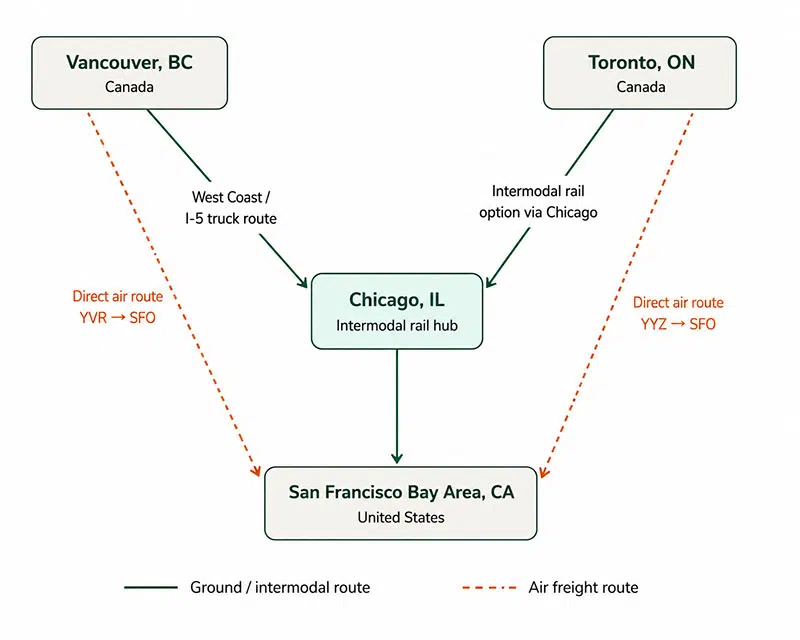
Toronto freight moving south often clears through Ontario land crossings for truck shipments or through Toronto Pearson for air cargo. When the destination is the San Francisco Bay Area, the routing may involve long-haul truck, air freight, rail intermodal, or a combination of linehaul and drayage depending on the delivery deadline.
Vancouver sits closer to the U.S. West Coast network. Ground shipments from Vancouver to Northern California often move through Pacific Northwest corridors before continuing down toward the Bay Area. For air cargo, Vancouver International Airport gives importers a direct route into major U.S. airport networks. The shorter geography changes the mode decision. A shipment that would justify rail or team-driver trucking from Toronto may move more naturally by standard truck from Vancouver.
San Francisco adds another layer. It is served by a major airport, a dense regional trucking market, and port-linked distribution networks across Northern California. That gives importers several routing choices, but it also means final-mile coordination matters. A clean border release does not help much if the delivery appointment, drayage window, or receiving dock schedule was not planned at the same time.
Toronto to San Francisco Shipping
Treating Toronto, Vancouver, and San Francisco as one uniform lane hides the real transportation difference.
Vancouver to San Francisco is a shorter West Coast lane. For many palletized shipments, full truckload or less than truckload service is the practical default. The distance is long enough to require planning, but not always long enough to justify the extra handling that comes with intermodal rail.
Toronto to San Francisco behaves more like a transcontinental move. The distance changes the economics. Rail intermodal can make sense for non-urgent freight where cost control matters more than speed. Truckload remains useful when capacity, control, or appointment timing matters. For urgent road moves, some carriers may use team drivers so the truck can keep moving through rest cycles, but that service costs more and has to be booked with realistic expectations.
Air freight sits outside that comparison. When a part is needed for a production line, a retail launch date is fixed, or the cargo value justifies the premium, air can be the right answer even when the rate looks expensive beside ground transport.
LTL, FTL, and Intermodal Freight
Full truckload is usually the cleanest road option when the shipment can fill a trailer or needs dedicated capacity. It reduces terminal handling and keeps the load under one trailer plan for most of the trip. The tradeoff is that the shipper pays for the space whether the trailer is full or not.
Less than truckload works for smaller shipments that do not justify a dedicated trailer. It is cost-effective for pallets and partial loads, but it adds terminal handling and more handoffs. That can matter for fragile goods, high-value items, or shipments with tight receiving appointments.
Rail intermodal is strongest where the shipment is heavy, non-urgent, and moving over a long distance. It can reduce linehaul cost on lanes such as Ontario to California, but it is less forgiving when pickup, rail cut-off, or final delivery timing is tight.
Ocean freight is not usually used for direct Canada-U.S. movement. Its role appears when overseas freight lands at a port and then moves inland through Canada or the United States. A container arriving on the West Coast may still need customs clearance, transloading, drayage, warehousing, and domestic distribution before the buyer receives the goods.
Air Freight for Urgent Cargo
Air freight is not just the fastest option. It is the option that becomes relevant when delay changes the value of the shipment.
Replacement parts, launch-date retail inventory, medical devices, electronics, and production-line components often fall into this category. If the cargo arrives late, the problem is larger than transportation cost. A delayed component can stop a line. A missed retail window can make the inventory less useful. A high-value shipment can also justify air because fewer handoffs may reduce exposure to damage or loss.
On the Toronto, Vancouver, and San Francisco lanes, air freight is usually considered when the delivery window is too short for road or rail. Economy air options may work where the cargo still needs to fly but does not require the highest-priority service. The decision should compare the air premium against the cost of the missed deadline, not against ground freight alone.
Cross-Border Freight Pricing
Air and LTL pricing often depend on chargeable weight, not just scale weight. Carriers compare the actual weight of a shipment with its dimensional weight and bill on the higher number.
For many LTL shipments, dimensional weight is calculated using a divisor such as 139 cubic inches per pound:
Dimensional Weight (lb) = Length × Width × Height ÷ 139
International air freight often uses an air-cargo convention based on 166 cubic inches per pound or 6,000 cubic centimetres per kilogram, depending on the rating method used.
The billing rule is simple:
Chargeable Weight = the greater of Actual Weight or Dimensional Weight
This is where pallet construction affects cost. A loosely stacked pallet with too much void space can rate higher than expected because the carrier is selling trailer or aircraft space, not just lifting capacity. Tight, consistent palletizing is one of the few cost controls an importer can influence before pickup.
CUSMA Duties and Tariffs
CUSMA can reduce or eliminate duty on qualifying goods moving between Canada, the United States, and Mexico. The word qualifying matters. The product must meet the applicable rule of origin, and the importer must claim the preference correctly at the time of entry.
A certification of origin is not the same as a casual country-of-origin statement. It has to contain the required data elements and be supported by records that prove the goods qualify. Those records may be requested after the shipment has cleared.
Some sectors carry additional tariff complexity outside the basic CUSMA preference claim. Steel, aluminum, and automotive goods can be affected by product-specific rules, origin requirements, or policy changes. An importer should not assume a shipment is duty-free just because the seller is located in Canada or the United States.
Cargo Insurance for Cross-Border Freight
Carrier liability is not the same as cargo insurance. That misunderstanding becomes expensive when the shipment is lost or damaged.
For international air carriage, liability is commonly limited by weight under the applicable air cargo liability regime. That means the compensation calculation is tied to weight, not the commercial value of the goods. The exact amount should be checked against the carrier’s current terms and the applicable convention at the time of shipment.
Road freight can have a similar gap. Standard bills of lading or carrier terms may limit liability unless a higher value is declared and accepted. For a business moving electronics, machinery parts, medical goods, or other high-value cargo between Toronto, Vancouver, and San Francisco, the carrier’s baseline liability may cover only a fraction of the actual loss.
All-risk cargo insurance is the usual way to address that gap. It should be priced and reviewed separately from the freight rate, especially for shipments with high declared value, multiple handoffs, or strict delivery commitments.
Border Delays in Canada-U.S. Shipping
Most border delays are not mysterious. They often come from small inconsistencies that prevent the broker, carrier, or customs system from matching the shipment cleanly.
Common problems include:
- Commercial invoice descriptions that are too vague to support the HS code
- Declared values that do not match the transaction or supporting documents
- Missing or outdated CUSMA certification of origin
- PARS or PAPS numbers that do not match between the carrier and broker filing
- Importer account setup that is incomplete in CARM
- RPP status or financial security issues on Canadian imports
- Product information that does not match permits, licences, or agency requirements
Undervaluation is especially risky. Trying to reduce duty exposure by lowering the invoice value can create penalties, inspections, and loss of trust with both customs authorities. The cost of fixing that problem is usually higher than the duty the importer was trying to avoid.
Freight Forwarder and Customs Broker
A customs broker and a freight forwarder do not always do the same job.
A customs broker handles the customs entry, tariff classification support, duty calculation, and filing with CBSA or CBP. A freight forwarder coordinates the movement of goods across carriers, modes, warehouses, and handoff points. Some providers offer both functions directly. Others coordinate with separate partners.
For importers shipping regularly between Toronto, Vancouver, and San Francisco, the value is in knowing where one role ends and the next begins. A broker may file the entry correctly, but if the carrier does not have the matching PARS or PAPS information, the truck can still wait. A forwarder may arrange the transportation properly, but if the importer has not completed the required CARM setup, the release can still fail.
Frequent shippers may also benefit from trusted trader or pre-approval programs where applicable. These programs do not remove the need for proper documentation, but they can improve border predictability for companies that ship regularly and meet the program requirements.
Cross-Border Shipping Strategy
Cross-border shipping between Canada and the United States rewards preparation more than last-minute problem solving. The freight mode matters, but it is only one part of the decision. The commercial invoice, HS classification, CUSMA claim, PARS or PAPS filing, importer account setup, liability terms, and insurance coverage all shape whether a shipment moves cleanly.
The route matters too. Vancouver to San Francisco is usually a West Coast highway decision. Toronto to San Francisco behaves like a long-haul or intermodal decision unless timing pushes the shipment into air freight. The same buyer, destination, and product can produce a different freight strategy depending on where the cargo starts.
Importers who treat compliance, transportation, and risk management as one connected process avoid more delays than companies that treat each shipment as a one-off booking. That is where a freight forwarder can add value: not by replacing the broker, carrier, or importer, but by keeping the moving parts aligned before the shipment reaches the border.