
Choosing the right Truck Freight option is not just about which quote looks lower. It is a planning decision that affects transit time, cargo handling, delivery windows, freight cost structure, border delay risk, and risk tolerance for high-value cargo. Less-Than-Truckload Freight can make sense when your shipment only needs part of a trailer and can move through a consolidated network, while Full-Truckload Freight is the stronger option when the load requires dedicated trailer space, direct routing, minimized physical handling, and no intermediate handling.
For businesses shipping across Canada, the USA, Ontario, and the GTA, the difference becomes especially important on cross-border lanes. LTL freight often moves through a hub-and-spoke network with other shipments, so delays can happen when another load in the trailer has paperwork, clearance, or terminal issues. FTL freight keeps your cargo on a dedicated trailer from pickup to destination, creating point-to-point movement with no intermediate handling. It can also be the better fit for strict delivery windows, high-value freight, oversized dimensions, or specialized trailer needs such as temperature-controlled or flatbed transportation. Cost also needs context: LTL pricing is usually tied to class-based rates, tariffs, discounts, and accessorial charges, while FTL pricing is more closely tied to trailer capacity, mileage, fuel, lane demand, seasonality, equipment type, and delivery requirements. This guide compares LTL vs FTL Freight by cost, speed, handling risk, border delay risk, equipment needs, cargo sensitivity, and operational fit before you book the shipment.
LTL vs FTL Freight: Key Differences at a Glance
Choose Less-Than-Truckload Freight when your shipment only needs partial trailer space, the delivery window is flexible enough for a consolidated network, and controlling freight spend matters more than having a dedicated trailer. It is the standard cost-control method for smaller, durable commercial loads that can move through shared freight networks. Choose Full-Truckload Freight when the shipment requires direct routing, tighter delivery control, minimized physical handling, or a dedicated trailer from pickup to destination.
| Factor | LTL Freight | FTL Freight |
|---|---|---|
| Best Use Case | Smaller shipments that only need part of a trailer. | Large shipments that need the entire trailer. |
| Typical Shipment Size | Partial loads, pallets, cartons, or commercial freight that can move through a shared network. | High-volume freight, full trailer loads, oversized cargo, or shipments that require dedicated capacity. |
| Trailer Space | Shared with other shipments. | Dedicated to one shipment. |
| Pricing Structure | Usually based on freight class, weight, tariffs, discounts, and accessorial charges. | Usually based on trailer capacity, mileage, fuel, lane demand, equipment type, and delivery requirements. |
| Cost Advantage | Often better for controlling spend on smaller, durable loads. | Often better value when volume, urgency, cargo value, or risk control justifies dedicated movement. |
| Transit Speed | Usually slower because freight may move through terminals or consolidated routes. | Usually faster because the shipment moves more directly from pickup to destination. |
| Delivery Window | Better for flexible timelines. | Better for strict delivery windows and must-arrive-by-date shipments. |
| Handling Risk | Higher handling exposure because freight may be loaded, unloaded, and transferred through terminals. | Lower handling exposure because cargo stays on the same trailer with no intermediate handling. |
| Cargo Sensitivity | Best for durable freight that can tolerate shared movement. | Better for high-value, fragile, sensitive, or damage-prone cargo. |
| Routing | Moves through a consolidated hub-and-spoke network. | Moves on a dedicated point-to-point route. |
| Cross-Border Shipping | Can face added dwell time if another shipment in the trailer has paperwork or clearance issues. | Helps reduce shared-shipment border delay risk through dedicated movement. |
| Equipment Needs | More limited for specialized trailer requirements. | Better for temperature-controlled, flatbed, oversized, or specialized trailer needs. |
| Best Choice When | You want to control cost and your freight can move through a shared network. | You need speed, direct routing, minimized handling, dedicated space, or stronger control over the shipment. |
In practical terms, LTL vs FTL Freight comes down to the trade-off between shared capacity and dedicated movement: FTL is the preferred standard for high-volume freight, high-value or sensitive cargo, strict delivery windows, oversized dimensions, and Canada–USA cross-border shipments where border dwell time risk needs to be minimized.
LTL vs. FTL: Which is More Cost-Effective for Your Cargo?
LTL freight can be the better cost-control option when your shipment only uses part of a trailer and can move through a consolidated network without strict timing or handling requirements. Instead of paying for dedicated capacity, the cost is usually shaped by class-based rates, shipment weight, tariffs, discounts, and accessorial charges such as liftgate service, limited access delivery, appointment requirements, or inside delivery.
FTL freight starts to make more financial sense when the shipment size, delivery deadline, cargo value, or handling risk justifies dedicated trailer capacity. Cost is more closely tied to distance, trailer capacity, fuel, lane demand, market capacity, equipment type, and delivery requirements. A full-truckload move may cost more upfront, but it can reduce indirect costs tied to terminal handling, border dwell time risk, missed delivery windows, and damage exposure. It can also become the more practical option when freight takes up significant linear footage, even if the shipment is not extremely heavy. The cheaper quote is not always the better freight decision; the right choice is the one that protects the total cost of the shipment from booking to delivery.
LTL or FTL? Assessing Freight Dimensions, Pallet Counts, and Linear Footage
Shipment size is one of the first clues in the LTL vs FTL Freight decision, but it should not be judged by pallet count alone. Less-Than-Truckload Freight is usually the practical choice when a shipment uses only part of the trailer and can be handled through a consolidated network. That may include palletized freight, boxed commercial goods, or smaller loads where the weight, dimensions, and delivery schedule do not justify dedicated trailer capacity.
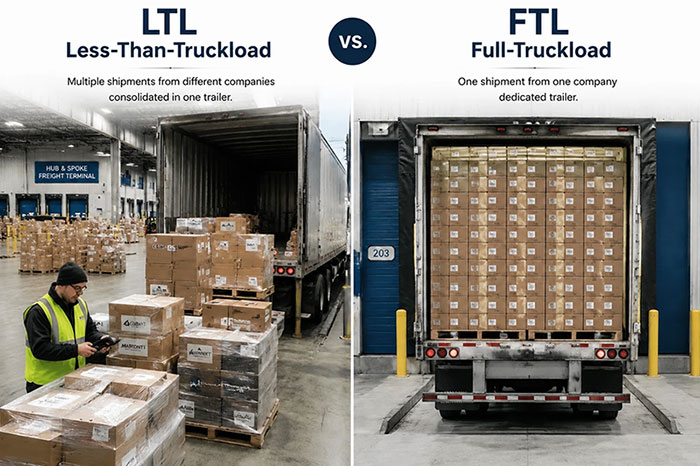
Full-Truckload Freight becomes more relevant when the shipment takes up enough trailer space to create loading complexity or reduce the value of shared freight pricing. As a general planning guide, freight that approaches 10 to 12 pallets, takes up significant linear footage, or includes long or oversized pieces may start to move into the grey area between LTL and FTL. A load does not have to max out the legal weight limit to justify FTL; the stronger choice depends on how the freight uses space, how it needs to be loaded, and whether the trailer should be reserved for one shipment from pickup to destination.
LTL vs. FTL Transit Times: Which Method Delivers Faster?
Speed in freight is not only about how fast the truck moves. It is about how many steps sit between pickup and delivery. LTL freight often moves through a consolidated network, where shipments may be sorted, transferred, consolidated, and de-consolidated at terminals before final delivery. That structure can be a cost-efficient choice for shipments with flexible delivery schedules, but it creates potential for compounding delays when freight needs to arrive on a specific day or within a tighter receiving window.
FTL freight operations bypass the terminal network entirely, providing dedicated point-to-point transit that eliminates the time-consuming sorting cycles of LTL. Because the trailer is assigned to one shipment, the freight avoids mid-route transloading, reducing the risk of warehouse transfer errors, missed terminal cuts, and unplanned handling delays. For must-arrive-by-date shipments, retail rollouts, production schedules, cross-border freight, or high-value cargo, direct routing helps protect delivery timing and gives your business a clearer ETA before the truck leaves the dock. On Canada–USA lanes, FTL can also reduce shared-shipment border delay risk because the trailer is not dependent on the paperwork or clearance status of other loads moving in the same unit.
LTL Hubs vs. FTL Direct: Where Does the Risk of Damage Hide?
Handling risk is one of the clearest differences between LTL and FTL freight. In Less-Than-Truckload Freight, cargo moves through a shared network where it may be unloaded, sorted, reloaded, and transferred before final delivery. Those multiple touchpoints help make LTL cost-efficient for smaller shipments, but they also raise the risk of physical compromise through terminal congestion, warehouse transfer errors, packaging stress, top-loading risk, and environmental issues from incompatible freight such as odours, chemicals, irregular cargo, or poorly separated loads.
Full-Truckload Freight reduces that risk by keeping the shipment on a dedicated trailer from pickup to destination. Under normal FTL movement, the cargo does not move through the same consolidation cycle, and there is no mid-route transloading. For high-value freight, fragile goods, industrial equipment, retail rollouts, or shipments where condition matters as much as timing, dedicated trailer movement creates a sealed, minimal-touch environment with an intact chain of custody from origin to final delivery.