
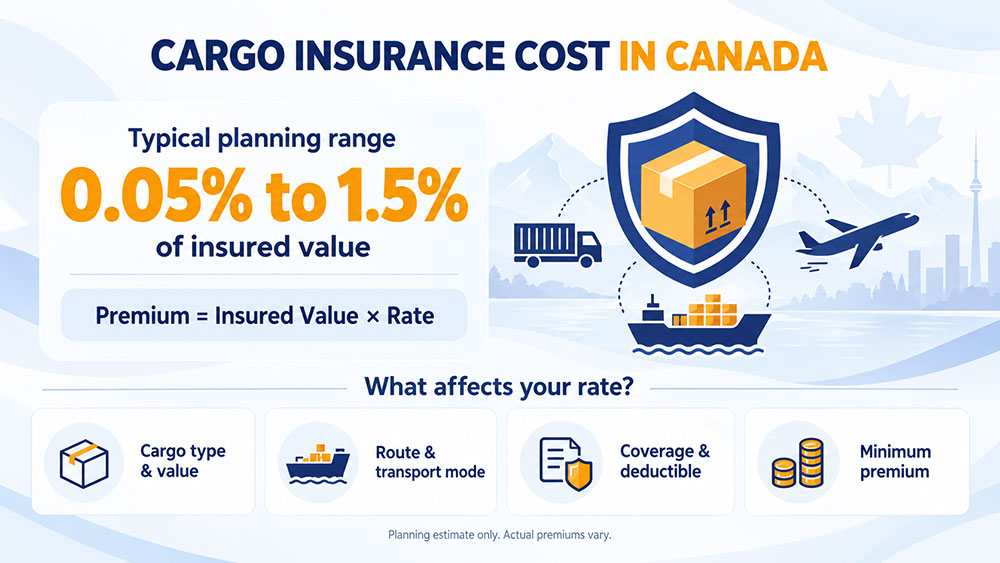
Cargo insurance in Canada is usually priced as a percentage of the shipment’s insured value, most often somewhere between 0.05% and 1.5%. On a $100,000 shipment, that means a premium of roughly $50 to $1,500. Ordinary, well-packed general cargo on a familiar route sits near the bottom of that range, while electronics, fragile or temperature-sensitive goods, used equipment and higher-risk routes cost more. Many insurers also apply a minimum premium per shipment, which becomes the price when the percentage works out lower.
That range is a starting point for budgeting, not a price list. The premium for your shipment depends on what you are shipping, how it is packed, how it will travel, and the terms and deductible you choose. This guide explains how the premium is calculated, gives worked examples, shows what changes the rate, and compares the cost of insurance with what a carrier would actually pay if your cargo were lost or damaged.
We focus here on insurance a shipper buys to protect its own cargo, either for one shipment or under an annual policy. We do not cover motor truck cargo insurance that trucking companies carry for their fleets, which is priced very differently. All amounts are planning examples in Canadian dollars, not quotes. If you want a refresher on coverage types and claims first, read Cargo Insurance Explained, or see how Cargopedia arranges freight insurance for your shipments.
Typical Cargo Insurance Rates for Canadian Shipments
A practical budgeting range for cargo insurance is about 0.05% to 1.5% of the insured value. The lower end applies to straightforward general cargo on favourable terms. The upper end applies to shipments with a greater chance of loss, such as theft-targeted products, fragile goods or long multi-modal journeys. Some cargo falls outside this range altogether and needs individual underwriting.
The table shows how the rate translates into a base premium at different shipment values. It does not include any minimum premium, tax, policy fee or special endorsement.
| Insured value | At 0.10% | At 0.30% | At 0.75% | At 1.50% |
|---|---|---|---|---|
| $25,000 | $25 | $75 | $187.50 | $375 |
| $100,000 | $100 | $300 | $750 | $1,500 |
| $250,000 | $250 | $750 | $1,875 | $3,750 |
Always read a quoted rate together with the policy terms. A 0.20% rate with a $500 minimum premium still costs $500 if the percentage only comes to $200. A cheaper rate can also come with a higher deductible or narrower coverage, so comparing percentages alone can hide how much you would have to absorb after a loss. The useful comparison is the total premium, for the correct insured value, on terms that actually fit the shipment.
Cargo Insurance Cost by Transport Mode: Air, Ocean and Truck
People often ask whether air freight insurance or container insurance is cheaper. There is no fixed rule. Each mode carries different risks, and insurers price the whole journey, not just the main leg.
As an illustration, a 40-foot container of furniture worth $150,000 insured at 0.20% would carry a base premium of $300, while a $40,000 air shipment of laptops at 0.50% would cost $200. Both are examples only. Whichever mode you use, give the insurer the full door-to-door movement, including inland legs by truck or rail, so the whole transit is covered.
How Cargo Insurance Premiums Are Calculated
The basic formula is simple: premium = insured value × insurance rate. The harder part is agreeing on the insured value and the rate.
For goods covered by a marine policy, section 19 of Canada’s Marine Insurance Act describes insurable value as the prime cost of the goods plus shipping-related expenses and the cost of insurance, subject to any value set in the policy. In practice, the value on your quote should match both the insurance contract and the commercial documents for the shipment. Some policies or sales contracts also allow an agreed uplift above the cost of the goods and freight, often to cover incidental costs. Do not add a standard percentage automatically; confirm the valuation basis with the insurer and check that it fits the invoice, the Incoterm and the policy wording.
Here is a worked example. Goods worth $80,000 ship with $5,000 in freight charges. If the agreed insured value is $85,000 and the rate is 0.35%, the premium is $85,000 × 0.35% = $297.50. If the policy has a $350 minimum premium, you would pay $350 instead. If the insurer approves a 10% uplift, the insured value rises to $93,500 and the calculation becomes $327.25, still below the $350 minimum.
The deductible is separate from this calculation. It is the part of an insured loss you absorb yourself. A higher deductible may lower the rate, but the effect varies by insurer and shipment. Currency matters too: if the invoice is in U.S. dollars or euros, confirm which exchange rate and valuation date will appear on the certificate.
Is Cargo Insurance Worth It? What Carriers Actually Pay
Many shippers assume the carrier is responsible for the full value of anything it loses or damages. In reality, carrier liability in Canada is limited by law and by the bill of lading, usually to a small fraction of what modern goods are worth. These are the standard limits unless a higher value is declared and accepted, often for an extra charge:
| Mode | Standard carrier liability limit | What that means in practice |
|---|---|---|
| Truck (Canada) | $4.41 per kg ($2 per lb) or the actual value, whichever is lower | A 500 kg pallet is capped at about $2,205 |
| Air (Montreal Convention) | 26 SDR per kg, in force since December 28, 2024 | Roughly $45 to $50 per kg at recent exchange rates |
| Ocean (Hague-Visby Rules) | The greater of 666.67 SDR per package or 2 SDR per kg | About $1,200 per package or $3.60 per kg |
Even these amounts are only payable when the carrier is actually at fault, and carriers have defences for events like severe weather, perils of the sea or improper packing. Compare that with the cost of insurance. A 500 kg pallet of electronics worth $60,000 moving by truck would be capped at around $2,205 under the standard bill of lading terms. Insuring the full $60,000 at 0.30% would cost about $180. For most commercial cargo, the premium is a small price for closing that gap. If you are booking freight with us, you can add insurance to your shipping quote in the same request.
What Changes the Cost of Freight Insurance?
Insurers price the details of the shipment, not just the invoice value. Two loads worth exactly the same can receive different quotes because their routes, packaging or terms differ.

Route and handling affect exposure. A direct move presents a different risk from one that passes through several terminals or changes mode, and storage, consolidation, cross-docking and final-mile delivery should all be disclosed. Packaging matters as well: underwriters may ask whether goods are palletized, shrink-wrapped, blocked and braced, or packed in export crates, and high-value loads may need tracking or secure parking. Finally, coverage terms shape the price. All-risk cover costs more than cover limited to named perils, and deductibles, limits, war and strikes cover, temperature variation and storage extensions should be compared alongside the rate. For international sales, check the Incoterm first, because terms such as CIF and CIP decide who must arrange insurance, though not what it costs.
Single-Shipment and Open-Policy Pricing
A single-shipment policy covers one declared movement. The insurer reviews the goods, value, route, dates, mode and requested terms, then quotes a premium for that load. It suits occasional shipments, one-off projects, or businesses without an annual cargo program. Yes, you can insure just one shipment in Canada, but cover must be in place before the goods start moving.
An open policy covers recurring shipments over a policy period, usually a year. Pricing is based on estimated annual shipment values, commodities, routes, limits and loss history, and shipments are declared monthly or on another agreed schedule. That is usually what people mean when they see cargo insurance priced “per month”: instalments or monthly declarations under an annual policy, not a monthly rate for a single load.
| Pricing question | Single shipment | Open policy |
|---|---|---|
| What is being priced? | One identified load | A continuing shipping program |
| When is the premium set? | Before cover is bound for that shipment | At the start of the policy, then adjusted for declarations |
| Best fit | Occasional or unusual shipments | Frequent shipments with a consistent profile |
| Main information needed | Cargo, value, route, mode and dates | Annual values, shipment pattern, limits, routes and loss history |
An open policy can reduce paperwork and give more consistent pricing, but it is not automatically cheaper. Compare the total expected annual cost with your realistic shipment volume, rather than dividing a single-trip quote by twelve.
What You Need for an Accurate Cargo Insurance Quote
A good quote starts with a complete description of the shipment. “One pallet from Toronto to Vancouver” is rarely enough, and missing details can delay the quote or leave you with terms that do not match the actual movement. Have this ready:
- The legal name of the party that needs cover
- A clear description of the goods, and whether they are new or used
- The commercial invoice value and currency, plus any freight or costs to include
- Full origin and destination, including pickup and final delivery points
- Every transport mode, transfer and storage point along the way
- Departure date, expected transit time, and carrier details if known
- Packaging method, dimensions, weight and number of pieces
- Any temperature, dangerous goods, security or special-handling needs
- The Incoterm and who is responsible for arranging insurance
- Your preferred deductible, coverage limit and any extensions
When the quote arrives, check the insured value, currency, deductible, policy period, geographic limits, exclusions and any commodity sub-limits, and confirm whether taxes and fees are included. The certificate should name the right insured party and describe the transit from the real starting point to the real destination. For high-value imports, our guide to shipping high-value cargo from China covers the packing and security steps insurers look for.
Minimum Premiums and Coverage Limits
Most insurers set a minimum premium for single shipments, so a low-value load can cost the same to insure as a somewhat larger one. Minimums vary by provider, commodity and route, which is why a quote that looks expensive for a small shipment is often just the minimum at work. If you ship small consignments regularly, an open policy can be a better fit because the minimum is applied once for the program rather than to every shipment.
Some providers also set minimum or maximum insured values per shipment, exclude certain commodities, or require extra approval above a stated limit. There is no single Canada-wide minimum price or coverage amount; the insurer’s underwriting rules and the policy wording decide what applies to your cargo. For very high-value shipments, ask early, because cover above a provider’s standard limit can take longer to arrange.
Timing is the other rule that catches people out. Cover has to be confirmed before the goods leave. Insurers will not normally cover a shipment that is already in transit, and never one where a loss has already happened. Build insurance into the booking process rather than treating it as an afterthought once the cargo is moving.
Frequently Asked Questions About Cargo Insurance Cost
How much does cargo insurance cost?
In Canada, cargo insurance usually costs about 0.05% to 1.5% of the insured value, so roughly $50 to $1,500 on a $100,000 shipment. A minimum premium per shipment often applies.
What is the average cost of cargo insurance?
For ordinary general cargo on a standard route, rates commonly fall in the 0.1% to 0.5% range. Higher-risk goods and routes push the rate up.
Is air freight insurance more expensive than ocean?
Not necessarily. Each mode has different risks and insurers price the full door-to-door journey, so the commodity, packing and route usually matter more than the mode itself.
Can I insure a single shipment?
Yes. Single-shipment cover is widely available for domestic and international movements, as long as it is arranged before the goods start moving.
Doesn’t the carrier already cover my goods?
Only up to its legal liability limit, such as $4.41 per kg for trucking in Canada, and only when it is at fault. Cargo insurance covers the real value of your goods.
Get a Cargo Insurance Quote With Your Freight Booking
Cargo insurance is one of the smallest costs on most shipments and one of the most important. A premium of a few hundred dollars can protect tens of thousands of dollars of goods that a carrier would only partly cover, if at all. The key to a fair price is giving the insurer an accurate picture of the cargo, the packing and the full route, and comparing quotes on total premium and terms rather than on the headline rate.
Cargopedia can arrange cover through third-party insurance providers alongside your freight, whether the shipment moves by air freight, ocean freight or truck. Send the cargo details with your shipping request, especially if the goods are high-value, fragile, temperature-sensitive or moving through several modes, and include the planned pickup date so the policy is in place before the cargo leaves.
When you are ready, request a quote for your shipment and its insurance together, or visit our cargo insurance services page to see how we handle cover and claims support.