
The cost to ship a car in Canada usually runs between CAD $1,100 and $2,800 for a standard sedan on an open carrier on a long-distance move, depending mostly on the route. Short regional moves like Toronto to Montreal cost much less, often $450 to $750, while coast-to-coast runs like Montreal to Vancouver sit at the top of the range. Enclosed transport usually costs 30% to 80% more on the same route, and larger vehicles, non-running cars and peak-season bookings all push the price higher.
Those averages only go so far, though. Most people searching for car shipping cost in Canada want a number for their own route, so this guide breaks prices down corridor by corridor, from Ontario to Alberta and British Columbia to Atlantic Canada, and then walks you through a simple estimate you can work out yourself before requesting quotes. We also cover what changes the price, when enclosed transport is worth paying for, how truck and rail compare, and what extra costs apply if you are bringing a car in from the United States.
All figures below are 2026 market ranges in Canadian dollars, before tax, for a running mid-size sedan. They are a planning tool, not a guaranteed rate. As a Toronto-based freight forwarder that arranges vehicle shipping across Canada, we see quotes move with the season, fuel prices and carrier availability, so use these ranges as a starting point for your budget.
Car Shipping Cost in Canada at a Glance (2026)
Before getting into individual routes, here is how the two main transport options compare across Canadian corridors. Open transport moves the large majority of vehicles in the country, while enclosed transport is a premium service built for vehicles where cosmetic condition matters most.
| Factor | Open Transport | Enclosed Transport |
|---|---|---|
| Typical cost, long-distance (CAD) | $1,100 – $2,800 | $1,900 – $4,400 |
| Typical cost, regional (under 800 km) | $450 – $900 | $800 – $1,500 |
| Premium over open | Baseline | Roughly 30% – 80% more on the same route |
| Protection | Exposed to weather and road spray | Fully shielded from weather, salt and debris |
| Carrier availability | High on all major corridors | Lower, especially off the main routes |
| Booking lead time | About 1 – 2 weeks is usually enough | Book 3+ weeks ahead in peak season |
| Best for | Daily drivers, used purchases, relocations | Classic, luxury, exotic and low-clearance cars |
The gap between the low and high end of each range is real and comes down to a handful of variables: exact pickup and delivery points, vehicle size, the month you ship, and how busy the corridor is when you book. Door-to-door delivery also costs more than dropping the car at a terminal, though it saves you two trips across town. If you already know your route, the next section gives you a much narrower range. If you want to see the full list of what goes into a freight price beyond cars, our guide to the factors behind transportation pricing covers fuel, accessorials and seasonality in more depth.
Car Shipping Prices by Route Across Canada
Route is the single biggest driver of your quote. The table below shows typical 2026 ranges for the corridors Canadians ask about most. Prices are for a running sedan on an open carrier unless noted, and are similar in both directions, though westbound and eastbound rates can differ by a few hundred dollars depending on where carriers need to reposition trucks.
| Route | Approx. distance | Open carrier (CAD) | Enclosed (CAD) | Typical transit |
|---|---|---|---|---|
| Toronto ↔ Calgary | 3,400 km | $1,450 – $2,200 | $2,300 – $3,800 | 4 – 7 days |
| Toronto ↔ Edmonton | 3,450 km | $1,450 – $2,200 | $2,300 – $3,800 | 5 – 8 days |
| Toronto ↔ Vancouver | 4,400 km | $1,600 – $2,500 | $2,200 – $4,000 | 7 – 14 days |
| Montreal ↔ Calgary | 3,700 km | $1,550 – $2,300 | $2,400 – $3,900 | 5 – 9 days |
| Montreal ↔ Vancouver | 4,800 km | $1,800 – $2,700 | $2,700 – $4,300 | 8 – 14 days |
| Toronto ↔ Winnipeg | 2,100 km | $1,100 – $1,700 | $1,800 – $2,800 | 3 – 6 days |
| Toronto ↔ Halifax | 1,800 km | $1,150 – $1,700 | $1,900 – $3,000 | 4 – 7 days |
| Calgary ↔ Halifax | 4,900 km | $1,900 – $2,800 | $2,900 – $4,400 | 8 – 14 days |
| Toronto ↔ Montreal | 540 km | $450 – $750 | $800 – $1,300 | 2 – 4 days |
Transit times are door-to-door estimates after pickup. They do not include the wait for a truck to be assigned, which is usually a few days on busy corridors and longer on less common routes or in winter. The sections below explain what shapes pricing on each of the main corridors.
Ontario to Alberta: Toronto to Calgary and Edmonton
The Ontario–Alberta corridor is one of the busiest vehicle lanes in the country, driven by steady relocation between the two provinces in both directions. For a standard sedan, shipping a car from Toronto to Calgary on an open carrier typically costs $1,450 to $2,200, and Calgary to Toronto falls in a similar range. Edmonton is priced almost identically to Calgary because the same westbound carriers serve both cities on most runs.
Because so many carriers work this lane, you can usually book open transport with one to two weeks’ notice and expect delivery within four to seven days of pickup. An SUV typically adds around $200 and a full-size pickup around $400 compared with a sedan. Prices climb during the summer moving season, when demand from relocating families peaks, and winter shipments can take a day or two longer when prairie storms slow the highways. If you are moving a household at the same time, combining the car with your belongings through a single provider is often simpler; see our car shipping services for how we handle Ontario–Alberta moves.
Ontario and British Columbia: Toronto to Vancouver
Toronto to Vancouver is the classic cross-Canada car move and the most expensive major corridor because of its length and the mountain section through the Rockies. Expect roughly $1,600 to $2,500 on an open carrier and $2,200 to $4,000 for enclosed transport, with Vancouver to Toronto priced about the same. If you are comparing the cost to ship a car from BC to Ontario with a move to Alberta, the difference is smaller than the extra 1,000 km suggests. On long hauls, the carrier’s fixed costs are spread over more kilometres, so the price per kilometre drops.
Transit times vary more on this lane than any other. In summer, seven to ten days after pickup is typical, while winter conditions on the mountain passes can stretch delivery to 10 to 14 days. Winter shipments on this route deal with road salt across Ontario and the Prairies and grit on the mountain passes, which is why owners of newer or higher-value vehicles often go enclosed between November and March. Rail is also an option for this corridor, though total door-to-door time is usually longer once terminal waits are included, and you will need to deliver the car to and collect it from a rail yard. Our team can quote both open and enclosed truck options for this route so you can compare like for like.
Quebec Routes: Montreal to Calgary, Vancouver and Toronto
Montreal sits further east than Toronto, so westbound shipments from Quebec usually cost a little more than the equivalent Toronto route. Shipping a car from Montreal to Calgary typically runs $1,550 to $2,300 on an open carrier, and Montreal to Vancouver $1,800 to $2,700. Many westbound carriers serve both Montreal and the Greater Toronto Area on the same run, which keeps these lanes competitive and usually adds only a day or so to transit.
Closer to home, Toronto to Montreal is one of the shortest and cheapest interprovincial moves in the country, generally $450 to $750 on an open carrier with delivery in two to four days. On short routes like this, the pickup and delivery details matter proportionally more: a downtown Montreal address with narrow streets or parking restrictions can mean meeting the truck at a nearby lot, which some carriers price differently from a simple suburban driveway. Whatever the route, have your vehicle registration and photo ID ready at pickup and delivery, since the driver will check them against the bill of lading. If convenience is your priority, our door-to-door shipping option removes the need to arrange drop-offs at either end.
Atlantic Canada: Halifax, Nova Scotia and Newfoundland
Moving a car between Ontario and Nova Scotia typically costs $1,150 to $1,700 on an open carrier, with delivery in four to seven days. The Toronto–Halifax lane is well served, but there are fewer trucks than on western routes, so booking a little earlier helps, especially from late spring through early fall. Shipping from Alberta to Nova Scotia is a much longer haul, usually $1,900 to $2,800 on an open carrier, and transit can run up to two weeks.
Newfoundland is a special case. Every vehicle crosses by ferry from North Sydney, which adds both cost and scheduling constraints that mainland routes do not have. Expect a noticeable premium over a comparable mainland distance, and allow extra time during winter, when sailings can be delayed by weather. Prince Edward Island and New Brunswick are both reachable by road, but fewer carriers serve them than Halifax, so quotes can vary more from one company to the next. For any Atlantic route, it is worth confirming whether the quote includes the ferry or bridge charges and whether delivery is to your door or to a terminal in the region.
Car Shipping Cost Estimator: Work Out Your Price in 4 Steps
If your route is not in the table above, you can build a reasonable estimate yourself. This is the same logic carriers use when pricing a quote, simplified so you can do it in a couple of minutes. It will not replace a firm quote, but it will tell you whether a price you receive is in the right range.
Step 1: Find your base price by distance. Use the driving distance between pickup and delivery cities and find the matching band below. Long-haul rates are cheaper per kilometre because fixed costs are spread over a longer trip.
| Distance band | Base price, open carrier, sedan (CAD) |
|---|---|
| Under 800 km | $450 – $900 |
| 800 – 2,000 km | $900 – $1,700 |
| 2,000 – 3,500 km | $1,200 – $2,200 |
| Over 3,500 km | $1,600 – $2,800 |
Step 2: Adjust for your vehicle. Add about $200 for a mid-size or full-size SUV, about $400 for a full-size pickup or van, and more for lifted, modified or oversized vehicles. A car that does not run usually adds 20% to 25% because it needs a winch or special loading.
Step 3: Choose your service level. Multiply by 1.3 to 1.8 if you want enclosed transport. Door-to-door service typically costs about $150 to $300 more than dropping the car off and picking it up at a terminal.
Step 4: Adjust for timing. The ranges above already cover quiet and busy weeks. Summer bookings usually land in the upper half of the range, and short-notice or guaranteed pickup dates can push the price above it. Shipping in mid-winter often lands at the lower end, as long as you can live with a slightly longer transit window.
For example, a mid-size SUV going from Toronto to Calgary in July on an open carrier would start at roughly $1,450 to $2,200. Add about $200 for the SUV, which gives $1,650 to $2,400, and because July is peak season, expect a quote in the upper half of that range, around $2,000 to $2,400. When you are ready for a firm number, get an exact price for your route and we will confirm pickup windows and what is included.
What Drives the Cost to Ship a Car in Canada
Distance sets the baseline, but it does not scale in a straight line. A long-haul move along a busy corridor like the Trans-Canada tends to cost less per kilometre than a short regional run, because carriers on high-volume routes fill their trucks more reliably and spread fixed costs over more distance. Beyond distance, these are the factors that most often move the price:
- Vehicle size and weight: trucks, large SUVs and vans take up more deck space on a multi-car carrier, and some need a specific position on the trailer.
- Pickup and delivery access: door-to-door is more convenient but costs more than terminal-to-terminal, and tight urban streets can require meeting the truck nearby.
- Season and demand: summer relocation season is the busiest time on most corridors, while mid-winter is often softer on price but slower on transit.
- Route volume: lanes between Toronto, Montreal, Calgary, Edmonton and Vancouver are priced most competitively; smaller towns and remote areas cost more.
- Vehicle condition: non-running vehicles typically add 20% to 25% for winching and handling.
- Fuel: most carriers apply a fuel surcharge that follows diesel prices, so quotes can move between months.
Remote destinations are a category of their own. Shipping to or from the Yukon, Northwest Territories or northern parts of the provinces involves limited carrier availability and, on some roads, seasonal access, so prices can be well above the ranges in this guide. Insurance is another variable: standard carrier liability is included in most quotes, but coverage limits and deductibles vary. If you are moving a high-value vehicle, compare that coverage against our cargo insurance options or read our breakdown of what cargo insurance costs before you decide.
Open vs. Enclosed Transport: When Is the Premium Worth It?
Open transport handles the large majority of vehicle shipments in Canada. It is the same method manufacturers use to move new vehicles from plants to dealerships, and it is the standard choice for everyday cars, used vehicle purchases and most interprovincial moves. Vehicles ride on a multi-car carrier above road level, which keeps them clear of most road debris, and because these trucks run frequently on every major corridor, scheduling is flexible and prices are lower.
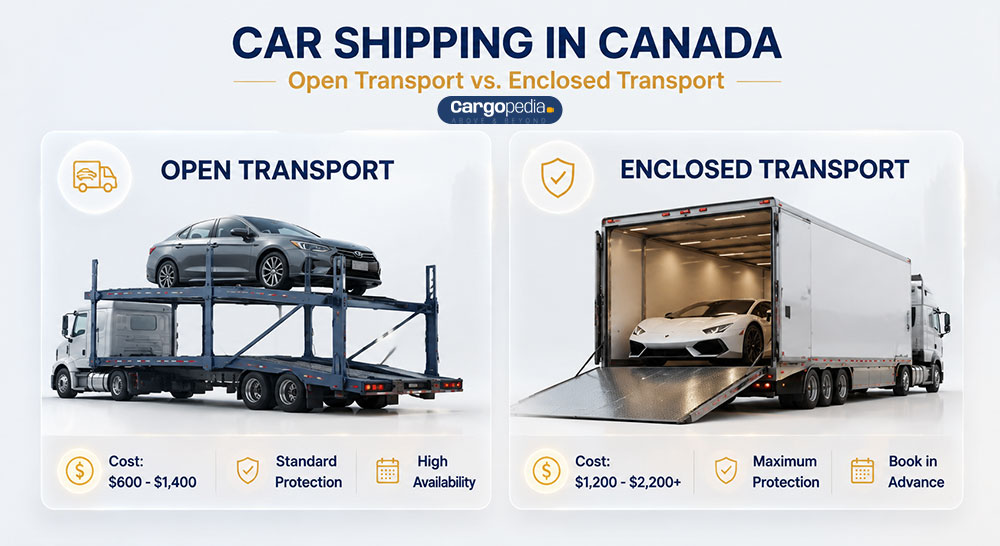
For mainstream vehicles, the picture is different. A daily driver or a used SUV moving across the country does not carry the same exposure risk, and most arrive with nothing more than road dust. Season and route still matter: a winter haul through salt-heavy sections of Ontario or across the Rockies is not the same as a summer run between dry prairie cities. If cosmetic condition is important to you, ask for both open and enclosed quotes on the same dates so you can see the real difference for your route rather than relying on a percentage.
Truck, Rail or Drive It Yourself: The Cheapest Way to Ship a Car in Canada
If price is your main concern, it is worth comparing three options. A truck carrier, either open or enclosed, is the most common choice and usually the most convenient, because the car can be collected from and delivered to your door or a nearby point. On busy corridors, open truck transport is also typically the cheapest professional option once you count the full door-to-door cost.
Rail can look competitive on long routes such as Toronto to Vancouver, but it only runs between rail terminals, so you need to get the car to the yard and collect it at the other end. Published rail ranges for long corridors are often in a similar band to open truck rates, and total transit is usually longer once you include the wait for a departure and terminal processing. Driving the car yourself is the other alternative. On a cross-country trip, fuel, four or five nights in hotels, meals, time off work and several thousand kilometres of wear can easily add up to more than a shipping quote, before you count the risk of winter driving.
To keep your cost as low as possible, a few habits help: be flexible on pickup dates by a few days, choose terminal drop-off if a terminal is convenient, avoid peak summer weeks when you can, and book open transport for any vehicle that does not need enclosed protection. Comparing quotes on the same terms also matters; a lower headline price that excludes fuel surcharges or insurance can end up more expensive. If you are shipping more than one vehicle, or moving a car alongside household goods or business equipment, ask about combined pricing through our truck freight services.
Shipping a Car from the U.S. to Canada: Transport Plus Import Costs
Bringing a vehicle in from the United States involves two separate costs: the transport itself and the cost of importing the car into Canada. Pickups in states close to the border cost less to move than long hauls from places like Florida, Texas or California, and pricing also depends on how far the pickup is from the main interstate routes. Some owners have the car delivered to a U.S. location near the border and drive it across themselves to save on cross-border handling.
On the import side, plan for several fees. Most vehicles under 15 years old must go through the Registrar of Imported Vehicles (RIV) program, which currently charges $325 plus GST/HST per vehicle. GST is charged on the vehicle’s value at the border, along with any provincial sales tax at registration. Vehicles that qualify under CUSMA are generally duty-free, while vehicles built outside North America are subject to 6.1% duty. Cars with air conditioning pay a $100 excise tax, and fuel-inefficient vehicles may pay a green levy. In addition, U.S. Customs requires export paperwork to be filed at least 72 hours before the vehicle reaches the border. Check whether any additional measures apply to U.S.-assembled vehicles at the time you import, because trade rules can change.
Paperwork mistakes are a common reason cars get held at the border, which is why many importers use a licensed customs broker. Our customs brokerage team can handle the entry, the RIV documentation and the export filing alongside the transport, so the car moves through in one coordinated process. Our guide to import fees in Canada explains how duties and taxes are calculated in more detail.
What to Compare in Car Shipping Quotes
Getting several quotes is the right starting point, but the lowest number is not automatically the best outcome. Ask for an itemized breakdown rather than a single total. A transparent quote separates the base transport rate from fuel surcharges and any seasonal, access or non-running fees, which makes quotes from different companies comparable and helps you spot add-ons before you book rather than at delivery.
Check the carrier’s policy on personal belongings before you pack anything into the car. Many Canadian carriers restrict or prohibit items inside the vehicle for weight and liability reasons, and some will refuse a car at the yard if it is loaded with belongings. Finally, ask how the pickup window works on your route. On busy corridors like Toronto to Calgary or Toronto to Vancouver, open transport schedules are flexible, but on less common routes or in peak season, availability tightens quickly. If you need a guaranteed pickup date, ask for that price specifically rather than assuming the standard quote includes it. For winter shipments, our article on winter trucking challenges in Canada explains why timelines stretch in the cold months.
Frequently Asked Questions About Car Shipping Costs in Canada
How much does it cost to ship a car across Canada?
Shipping a sedan coast to coast, for example Toronto to Vancouver or Montreal to Vancouver, typically costs $1,600 to $2,700 on an open carrier and $2,200 to $4,300 enclosed in 2026. The final price depends on exact pickup and delivery points, vehicle size and season.
How much does it cost to ship a car from Ontario to Alberta?
Toronto to Calgary or Edmonton generally costs $1,450 to $2,200 on an open carrier for a standard car, with delivery in about four to eight days after pickup. Alberta to Ontario is priced in a similar range.
What is the cheapest way to ship a car in Canada?
Open truck transport with terminal drop-off and flexible dates is usually the cheapest door-to-door option. Shipping outside the summer peak and avoiding guaranteed pickup dates also lowers the price.
How long does car shipping take in Canada?
Regional moves usually take two to four days, Ontario to Alberta four to eight days, and coast-to-coast routes seven to 14 days after pickup, with winter adding time on mountain and prairie routes.
Is it cheaper to ship a car or drive it across Canada?
On long routes, shipping is often comparable to or cheaper than driving once fuel, hotels, meals, time off and vehicle wear are included, and it avoids winter driving risk.
Is there a car shipping cost calculator for Canada?
Online calculators can only give a rough range because carriers price each lane by current demand. The four-step estimator above gives you a comparable range in minutes, and a quote confirms the exact price for your dates.
Get an Accurate Car Shipping Quote for Your Route
Car shipping costs in Canada follow predictable patterns once you know what drives them. Distance and corridor volume set the base, vehicle size and condition adjust it, enclosed transport adds a premium that is worth paying for some vehicles and not others, and season moves prices up or down around the edges. Busy lanes such as Ontario to Alberta and Toronto to Vancouver offer the most competitive rates and the most flexible schedules, while Atlantic, northern and smaller-town routes cost more and need more lead time.
The ranges in this guide will help you budget and judge whether a quote is reasonable, but the only way to know your exact price is to price your specific route, vehicle and dates. Cargopedia arranges open and enclosed car transport across Canada and between Canada and the United States, and can combine the move with customs clearance, insurance or household shipping when you need it. For international moves, our comparison of RoRo, container and air freight for cars explains the options for shipping overseas.
Tell us your pickup and delivery cities, vehicle and preferred dates, and we will come back with a clear, itemized price. Request your car shipping quote and see what your move will really cost.