
Air freight rates for shipments into Canada usually run from about US$2.50 to US$4.50 per chargeable kilogram from Europe and US$6 to US$8.50 per kilogram from China for standard airport-to-airport cargo, with door-to-door service, urgent bookings and peak-season space all pushing the price higher. Express courier service for small, urgent shipments can run US$12 to US$18 per kilogram or more.
Those numbers only make sense once you know how air cargo is priced. Airlines charge by chargeable weight, not scale weight, so a light but bulky shipment can cost far more than its weight suggests. Rates also drop as a shipment moves into higher weight brackets, and the per-kilogram rate is only one line on the final invoice: fuel and security surcharges, terminal handling, customs clearance and delivery all sit on top of it.
This guide explains what air freight costs in 2026, how weight breaks and chargeable weight work, which charges to expect beyond the freight rate, and how to compare quotes properly. The figures are planning ranges for ordinary commercial cargo moving through major gateways such as Toronto Pearson, Vancouver and Montreal. They are not a tariff, and the actual rate for your shipment will depend on the lane, the date and available capacity. For shipments you are ready to move, our air freight services page explains how we handle bookings from origin pickup to final delivery.
Air Freight Cost per Kg in 2026: Quick Reference
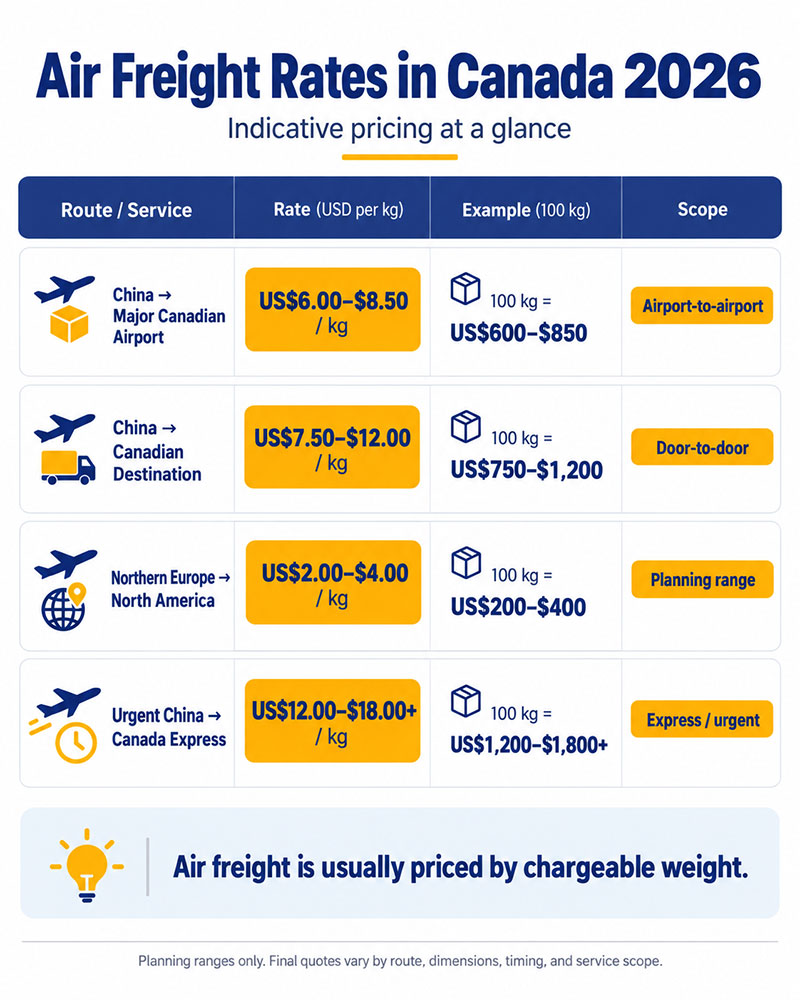
The table below gives typical planning ranges for common lanes into Canada. Rates are shown in U.S. dollars because international air cargo is usually quoted that way, and they apply to general cargo on a per-chargeable-kilogram basis.
| Lane and service | Typical rate (US$/kg) | Approx. cost at 100 kg chargeable | What is usually included |
|---|---|---|---|
| China → major Canadian airport | $6.00 – $8.50 | $600 – $850 | Airport-to-airport freight |
| China → Canadian address | $7.50 – $12.00 | $750 – $1,200 | Pickup, flight, destination handling and delivery |
| Europe → major Canadian airport | $2.50 – $4.50 | $250 – $450 | Airport-to-airport freight |
| Urgent express or courier | $12.00 – $18.00+ | $1,200 – $1,800+ | Small, time-critical shipments, usually door-to-door |
These ranges are for general cargo during normal market conditions, and the high end of each band is where peak-season and short-notice bookings land. Dangerous goods, oversized pieces, temperature-controlled cargo and high-value shipments are priced separately. Duties, taxes, customs exams and storage are not included in any of the figures above.
Air cargo prices move quickly, so it is worth knowing where the market is right now. In October 2026, the Freightos Air Index put China to North America rates at about US$6.88/kg after a 19% jump in a single week, and the TAC Index reported global air freight rates more than 26% higher than a year earlier. Jet fuel, which sets a floor under what airlines will accept for cargo, was more than double its price from a year before. With the November to December peak season ahead, shippers should expect the upper half of these ranges on Asian lanes until the new year.
How Air Freight Rates Work: Weight Breaks and Minimum Charges
Air freight is not priced at one flat rate per kilogram. Airlines and forwarders use weight breaks, which are brackets where the rate per kilogram drops as the shipment gets heavier. The standard breaks used across the industry are under 45 kg, +45 kg, +100 kg, +300 kg, +500 kg and +1,000 kg. Moving from one bracket to the next can lower the rate noticeably, which is why a 290 kg shipment is sometimes cheaper to rate at 300 kg than at its actual weight.
| Weight break | How it is used |
|---|---|
| Minimum charge | A flat charge that applies to very small shipments, whatever their weight |
| Under 45 kg (normal rate) | The highest per-kilogram rate; typical for samples and small consignments |
| +45 kg and +100 kg | Common brackets for small commercial shipments of a few cartons |
| +300 kg and +500 kg | Pallet-sized shipments; rates are noticeably lower per kilogram |
| +1,000 kg | Larger consignments; usually the lowest rate and often negotiated per shipment |
Every shipment also faces a minimum charge. If you are sending one 8 kg carton of parts, the bill will not be 8 times the per-kilogram rate; it will be the minimum for that lane, plus fees. This is why consolidating several small orders into one air shipment often costs much less than sending them separately. A forwarder that consolidates cargo from many customers can also buy space at heavier weight breaks than a single small shipper could reach on its own, and pass on part of that saving.
Chargeable Weight: Why You Might Pay for More Than the Scale Shows
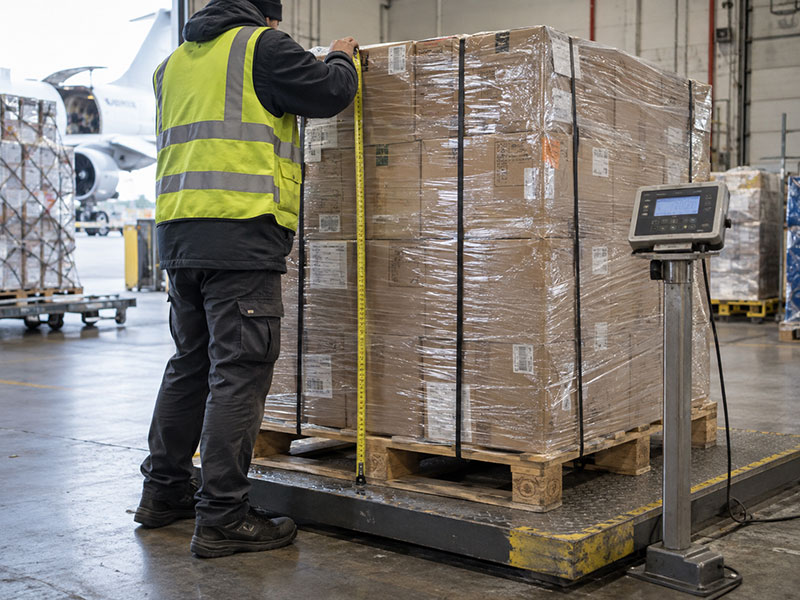
Aircraft run out of space before they run out of weight capacity on many flights, so air cargo is priced on chargeable weight. Chargeable weight is the higher of the shipment’s actual weight and its volumetric (dimensional) weight. For international air freight, volumetric weight is normally calculated as length × width × height in centimetres, divided by 6,000.
Here is how that plays out. A carton measuring 120 × 80 × 75 cm has a volumetric weight of 120 kg (720,000 ÷ 6,000). If it only weighs 80 kg on the scale, it will still be billed at 120 kg. At US$7 per kilogram, that is about US$840 in base freight, not the US$560 you would get by using the scale weight, a difference of US$280 on a single carton.
Surcharges and Other Charges on an Air Freight Quote
The per-kilogram rate is only part of what you pay. A quote that looks cheap may cover the flight alone, while a higher one may include almost everything from pickup to delivery. These are the charges to look for on any air freight quote:
- Fuel surcharge: charged per kilogram and adjusted as jet fuel prices change; often somewhere between US$0.50 and US$2.00/kg, and higher when fuel spikes.
- Security surcharge and screening: applied per kilogram or per shipment, with extra screening fees for cargo that does not come from a known shipper.
- Terminal handling: charged at both origin and destination airports, usually per kilogram with a minimum.
- Air waybill fee: a flat charge for issuing the transport document.
- Pickup and delivery: trucking between the airport and your supplier or warehouse.
- Customs clearance: brokerage fees for the Canadian import entry, plus duties and GST where they apply.
- Cargo insurance: optional coverage, usually priced as a small percentage of the cargo value.
Comparing quotes line by line is the only reliable way to see which one is actually cheaper. A rate of US$6.50/kg that excludes fuel, handling and delivery can easily end up more expensive than an all-in quote at US$8.25/kg. Our guide to freight accessorial charges explains the extra fees that most often appear after the fact, and the article on import fees in Canada covers duties, GST and broker fees in detail. If your cargo is valuable, compare the airline’s limited liability with proper cargo insurance before shipping.
Airline Rates vs. Freight Forwarder Quotes
Many shippers start by looking for rates from airlines such as Air Canada Cargo, WestJet Cargo or the large international carriers that fly into Toronto and Vancouver. In practice, most commercial air cargo is booked through freight forwarders rather than directly with the airline. Forwarders buy space from many carriers, consolidate shipments from different customers, and handle the work the airline does not: pickup, export documents, screening, customs clearance and delivery.
That is why airline cargo rates and the price a shipper pays rarely line up. The airline rate covers the flight between two airports. A forwarder’s quote combines that rate, at whatever weight break the forwarder can reach, with origin and destination charges and the services you need. For a small or medium shipment, the forwarder’s consolidated rate is often lower than what you could get as a one-off direct customer, and you get a single point of contact if anything goes wrong.
Using a forwarder also gives you options. On a busy lane like China to Toronto there may be several carriers and routings to choose from, including direct flights and connections through U.S. or European hubs, each with a different price and transit time. A good forwarder will tell you which option fits your deadline and budget instead of quoting a single airline. If you are importing regularly from China, our China to Toronto shipping page explains the air and ocean options on that route.
When Is Air Freight Worth the Cost Compared With Ocean?
Air freight costs several times more than ocean freight per kilogram, so it makes sense when speed or cargo value outweighs the price. A shipment from China to Toronto by air usually arrives within a week door to door, while ocean freight usually takes four to six weeks once you include the rail leg from Vancouver or Prince Rupert and port handling. If a delay would stop a production line, miss a retail launch or cost you a customer, that time difference is often worth far more than the extra freight.
Air also tends to make sense for small shipments. An ocean LCL shipment has fixed charges at both ends that do not shrink much for a few cartons, so the gap between air and ocean narrows for anything under a few hundred kilograms. High-value goods such as electronics, medical supplies, fashion and spare parts carry high inventory costs, which favours the faster mode. Bulky, heavy, low-value cargo is the opposite case and almost always belongs on a ship.
A practical rule of thumb: if the extra cost of air is small compared with the value of the goods or the cost of being late, fly it. If it is a large share of the product’s value and the timeline is flexible, ship it by sea. For a side-by-side look at both modes, see our comparison of air freight vs. sea freight and our guide to ocean freight costs.
How to Get an Accurate Air Freight Quote
A useful quote needs more than a total weight. The forwarder needs to know where the shipment starts, where it is going and what the packed cargo actually looks like. Have this information ready when you ask for a price:
- Pickup address and delivery address, or the airports if you only need airport-to-airport service
- Number of pieces, packed dimensions of each piece and total actual weight
- A clear commodity description, plus HS codes if you have them
- The date the cargo is ready and the date it needs to arrive
- Whether you need customs clearance, insurance or delivery to a specific site
- Any special requirements: batteries, chemicals, temperature control or oversized items
Finally, use the ranges in this guide as a sense check. If a standard 100 kg general cargo shipment from China is quoted at several times the planning range, there should be a clear reason, such as an urgent flight, an oversized piece or a remote delivery address. A quote far below the range deserves the same scrutiny: check what has been left out. When you have your shipment details, request an air freight quote and we will price it against the service you actually need.
Frequently Asked Questions About Air Freight Rates
How much does air freight cost per kg?
For general cargo into Canada in 2026, expect roughly US$2.50 to US$4.50/kg from Europe and US$6 to US$8.50/kg from China for airport-to-airport service. Door-to-door service, peak season and urgent bookings cost more, and express courier service can exceed US$12 to US$18/kg.
How is air freight cost calculated?
The rate per kilogram is multiplied by the chargeable weight, which is the higher of actual weight and volumetric weight (L × W × H in cm ÷ 6,000). Fuel and security surcharges, handling, documentation, customs and delivery are then added.
Why are air freight rates so high right now?
In late 2026, rates rose because of the pre-holiday peak season, strong demand on transpacific lanes and jet fuel prices that are roughly double last year’s level. Airlines pass much of the fuel cost on through fuel surcharges.
Is there a minimum charge for air freight?
Yes. Every lane has a minimum charge that applies to small shipments regardless of weight, which is why one small carton can cost almost as much as several. Consolidating orders helps.
Can I book directly with an airline like Air Canada Cargo?
Most commercial shippers book through a freight forwarder, which buys space from airlines, consolidates cargo and handles documents, screening, customs and delivery. The airline rate covers only the flight between airports.
How long does air freight take to Canada?
From Asia or Europe, most shipments arrive within three to seven days door to door, depending on routing, connections and customs. Express services can be faster for small shipments.
Budgeting for Air Freight in 2026
For most shippers, the honest answer to “how much does air freight cost?” is a range rather than a single number. Standard commercial cargo from Europe into Canada usually sits between US$2.50 and US$4.50 per chargeable kilogram, while China to Canada typically falls between US$6 and US$8.50 for airport-to-airport service and higher for door-to-door. With peak season under way and fuel costs elevated, budgets for the rest of 2026 should lean toward the upper end of those ranges, especially on Asian lanes.
The ranges are a good starting point, but your real cost depends on chargeable weight, the weight break you reach, the routing and departure date, and what the quote includes beyond the flight. Getting packed dimensions right, consolidating small orders and booking early before peak periods are the simplest ways to keep the cost down. It also helps to look at your freight spend as a whole; our overview of what determines transportation prices covers the factors that apply across air, ocean and truck freight.
Cargopedia arranges air freight into and out of Canada from Toronto, with pickup, customs clearance and delivery handled in one booking when you need it. Send us your origin, destination, piece count, dimensions, weight and ready date, and we will come back with a clear, itemized price. Get your air freight price and see what your shipment will really cost.